.
Showing posts with label arctic sea ice. Show all posts

Sunday, January 7, 2018

The latest conspiracy theory from WUWT science deniers - losing their grip on ice

Sou | 2:52 AM Go to the first of 3 comments. Add a comment
The latest conspiracy theory from science deniers at WUWT is that the National Snow and Ice Data Center (NSIDC) is up to something nefarious. (Seeing nefarious intent in the most innocuous actions is one of the hallmarks of conspiratorial thinking.)

All the fuss was about a new version of NSIDC's Sea Ice Index. It's gone from version 2 to version 3. In the latest version, monthly averages are calculated in a different way. The new version only affects monthly averages, not anything else. From the analysis report:
The Sea Ice Index has been updated to Version 3 (V3). The key update in V3 is a change in the method for calculating the numerical monthly averages of sea ice extent and sea ice area data values; that is, the data distributed in .csv and .xlsx format. This change impacts only the monthly data values in the Sea Ice Index time series and not monthly sea ice extent and concentration maps that accompany the data product, that is, the .png, .tif, and shapefile archives. Daily data are also not impacted, nor are any current conclusions drawn from the Sea Ice Index data set about the state of sea ice in either the Arctic or the Antarctic. This change is being made in response to questions raised by users of the product concerning how the monthly average ice extent and areas are calculated.

Thursday, December 8, 2016

Just remember this moment, Anthony Watts! Dunning Kruger in the Arctic.

Sou | 4:26 PM Go to the first of 32 comments. Add a comment
Today, finally, Anthony Watts has written about the record low Arctic ice extent that is being observed in the Arctic (and Antarctic) (archived here). He copied and pasted a press release from the National Snow and Ice Data Center (with no link to the original, as usual). What I'm writing about is the weirdly ignorant comment he added at the top. Anthony wrote:
It’s weather folks, but do remember this moment the next time we get a record high Arctic sea ice extent, the same people that are caterwauling on Twitter right now about this will tell you that it doesn’t matter. 

Yep - just remember this moment


Oh my! Anthony won't see a record high in his lifetime. It's highly likely that no-one will -  for thousands of years at least. Even just going back over the satellite record, since October 1978, there hasn't been a high record in the average annual sea ice extent since 1982. (Data is here - and the spreadsheet is here) If you analyse the monthly records, most months have the record high recorded in the first year of observations - 1978 or 1979 - almost forty years ago. The exceptions are the months of: May (1985), July (1983), August (1983), and September (1980).

In other words, the most recent record high sea ice extent in the Arctic was in May 1985, more than 30 years ago! And that's just the satellite record. If you go back to 1953, except for January when the record high was in 1979, the latest monthly record highs were in 1971 or earlier - 45 years ago.

Tuesday, November 22, 2016

Weather weirdness in the Arctic - record high temperatures and record low sea ice

Sou | 8:55 AM Go to the first of 26 comments. Add a comment
The extraordinary situation in the Arctic has to be mentioned before too many more days have passed. I've no time to write a detailed article at the moment, so what I'll do instead is post some information that's been around the traps lately. First some tweets from Zach Labe (@ZLabe), who has been keeping us all informed on Twitter.

Sunday, September 18, 2016

One of the fastest Arctic sea ice growths on record!

Sou | 5:06 PM Go to the first of 6 comments. Add a comment
The Arctic sea ice extent reached a minimum a few days ago, to much consternation as usual at WUWT (here and here and here). Deniers don't much like reports about sea ice. It's a difficult measure for them. When there are open seas in the Arctic it's a stark reminder of just how much we are affecting the climate.

Below is a chart of Arctic sea ice extent, comparing 2016 ice extent to the average of recent decades and to the years 2007, 2012 and last year. This chart is from the National Institute of Polar Research. Click to view enlarged.

Figure 1 | Arctic sea ice extent for 2016, 2015, 2012 and 2007. Source: National Institute of Polar Research


Thursday, August 25, 2016

Time to look at the Arctic sea ice 2016

Sou | 12:15 AM Go to the first of 15 comments. Add a comment
There has been some unusual weather in the Arctic again and it's even captured the attention of deniers. Arctic ice watcher, Neven, has been keeping a close eye on arctic cyclones and their impact, aided by other people who have built up some knowledge in the subject. They are wondering if these sort of events will happen more often than they used to. Earlier this year, in early spring, Arctic sea ice was at record low levels for that time of the year. It's not kept this place however it is still very low, being currently the third lowest on record for the time of year, just above 2007.

Anthony Watts is a blogging climate conspiracy theorist who tries to downplay climate change. He has built up a reputation in the dim corners of the internet for promoting "climate hoax" conspiracy theories and "ice age cometh" articles. Yes, even this year, during the hottest decade on record, and what will probably be the third in a row hottest year on record, and after ten "hottest months" on record, and the hottest ever month on record. As the world heats up relentlessly, deniers are looking crazier and crazier.

Friday, April 8, 2016

Most of the Arctic sea ice is on land and other WUWT musings

Sou | 3:51 AM Go to the first of 10 comments. Add a comment
Arctic sea ice from 1953
 Willis Eschenbach has been wondering about sea ice trends of the past few decades. He's written a couple of articles but seems to me to be more interested in hiding the trends than exploring them. In today's article (archived here, latest here), he has used HadISST data from the UK Met Office Hadley Centre. I don't know why he chose that over the more often cited Sea Ice Index from the National Snow and Ice Data Center.  I think he's meant his title to this latest article to be sarcastic, in the way that the Dunning-Kruger set use sarcasm: "The Awful Terrible Horrible Global Sea Ice Crisis".

Willis decided to look at the data from 1974 only because he found that for Antarctica before that time there was not good data. Then he said he removed the seasonal component, which looks like he deducted something from each month. Since Willis used HadISST data, let's look at what the authors of the authoritative text on the subject found in the 2003 paper by Rayner et al:

Thursday, March 31, 2016

A longer view of Arctic sea ice: 1953 to now

Sou | 12:24 PM Go to the first of 16 comments. Add a comment
The other day I wrote about Arctic sea ice and showed a chart from Meier et al (2012). The chart went from 1953 to 2011. In case you can use these somewhere while you're talking Arctic sea ice, I've now got updated data and have plotted charts from 1953 to the present. I can do others if you want (just ask in the comments).

I'll be a bit busy over the next few days, so won't be able to respond immediately - should be within a few hours tops.

Tuesday, March 29, 2016

Another low: Richard Verney's Arctic sea ice fudge at WUWT

Sou | 10:33 PM Go to the first of 14 comments. Add a comment
Some of the "thoughts" of deniers at WUWT defy belief. I'm talking about a comment from WUWT regular Richard Verney today under an unusual article (for WUWT). The WUWT article was unusual because despite being posted by Anthony Watts, and despite it being a press release from a scientific organisation, and despite it being about how winter sea ice hit another record low maximum this year - there was no "claim" in the headline (archived here, latest here).  There was even a link to the NASA press release.

This is the comment that I'm talking about, from richard verney on March 29, 2016 at 1:48 am
They have satellite data going back to the early 1970s. They should use all the data, not just that post 1979, but then again the early 1970s would be inconvenient especially since the amount of ice observed today is more than in 1974.
He's wrong in his conspiracy ideation. The amount of Arctic sea ice observed today is a lot less than it was in 1974. Here are some plots of sea ice extent going back as far as the satellite era will travel.

Tuesday, January 26, 2016

Desperate Deniers Part 8: Conman Anthony Watts goes for broke at WUWT

Sou | 5:39 PM Go to the first of 30 comments. Add a comment
Anthony Watts is getting reckless again. No, not restless, but reckless. He's making a stand as a hard core wanna-be professional science disinformer who has become unhinged in his desperate denial.

Poor Anthony will never make it as a professional climate disinformer. The elite of the disinformation world see him as a useful idiot at best, but don't use him much these days. That's putting people like Pat Michaels in the "elite disinformer" category, with organisations like the George C Marshall Institute. They are followed by freelancers such as Marc Morano (I think he's landed a paid gig, but I class him as a freelancer), who'll say anything he's paid to say at double speed while wearing a cheesy grin. Then there are the "science" hacks for the GOP - Judith Curry, followed a long way behind (and dropping) by the unChristian duo from Alabama. Then there are all the faded jaded right wing lobby groups stacked with old white conservative men, getting older and probably fewer year by year. The pseudo-religious anti-environment groups don't count for much, but they do manage to wheedle funds from various vested interests. Way down the bottom of the disinformation totem pole are the climate conspiracy bloggers, Anthony Watts, Jo "Nova" and her rocket scientist from Luna Park and a straggle raggle taggle of other wanna-bes. Some of them are managing to stay a few inches ahead of "Steve Goddard"/Tony Heller and the twit, Tom Nelson.

Today Anthony Watts has a second article about something that former US Vice President, Al Gore may or may not have said back in 2006 (archived here). Anthony was delighted to see his previous version of the same thing all over various dumb blogs. He thinks he's on a winner but I'd guess he's despondent that it didn't hit the mainstream media. (In your dreams, Anthony.) He didn't write this all by himself (he rarely does). He says he pinched it from a blog on some financial website and added some embellishments of his own.

What could go wrong?

Friday, August 28, 2015

Arctic sea ice extent is fourth lowest so far this year

Sou | 10:34 PM Go to the first of 23 comments. Add a comment
It's that time of the year again when the sea ice in the Arctic is disappearing. It doesn't look as if there will be a record low extent this year, but there's not a lot of ice around. At the moment it's the fourth lowest on record for this time of the year, according to the interactive chart provided by NSIDC (with my annotations).

Source: National Snow and Ice Data Center (NSIDC)

There are links to most of the main sea ice pages on the HotWhopper Climate Metrics page. Here are a couple of charts from the University of Bremen, as at 28 August 2015:


To stay up to date with what's happening, go to Neven's Arctic Sea Ice Blog.  His latest article is about a storm in the Beaufort Sea, which is undoubtedly breaking up ice in that region.

There's not much more to say, except to express concern that the region is at high risk. Not just from melting sea ice and all the changes that brings, but from shipping traffic and resource exploration. Those risks affect the Arctic and because of the wider impact of changes in the Arctic, affect the whole world.

I'll keep an eye on things and probably post an article shortly after the minimum, which should be within the next three weeks.

Wednesday, April 29, 2015

Bombshell! Dumb Denialism from Anthony Watts about Arctic Sea Ice

Sou | 3:30 PM Go to the first of 5 comments. Add a comment
Arctic sea ice is declining rapidly, yet Anthony Watts sez it may rebound! Is he claiming that an ice age cometh? Not really. He usually leaves that nonsense to his "essayists" like David "funny sunny" Archibald. Yet if you read his headline without the article he copied and pasted (archived here), that's the conclusion you'd draw.

Here's Anthony's wrong headline:
BOMBSHELL: Scripps says Arctic Sea Ice may return, forecasts of loss based on ‘oversimplified arguments’

Once again, as usual, Anthony couldn't understand a simple press release - or if he did he decided to mislead his readers.  (Which is worse - being seen as an idiot or as a liar?)

Anthony Watts and his bombshells are usually a flop - his bombshells have a habit of going pear-shaped:)

The paper that he referenced was by Till J.W. Wagner and Ian Eisenman of the Scripps Institution of Oceanography. It was about how:
  • Arctic sea ice is disappearing because of global warming, but
  • IF greenhouse gases dropped (or we were desperate enough to do some geo-engineering) and the Earth cooled again
  • THEN the disappeared Arctic sea ice would come back
  • ELSE it won't! 

Thursday, February 5, 2015

Jim Steele brings the Arctic to Antarctica

Sou | 7:31 PM Go to the first of 16 comments. Add a comment


There's a very odd article at WUWT by Jim Steele about Antarctic sea ice (archived here, latest here). He started off the article saying he'd just read a new paper about Arctic sea ice. The paper, by Neil Swart and colleagues was published in Nature at the end of January.

The introduction to the paper sets the scene:
Internal climate variability can mask or enhance human-induced sea-ice loss on timescales ranging from years to decades. It must be properly accounted for when considering observations, understanding projections and evaluating models.

The scientists were looking at trends in Arctic sea ice in recent years. What they were looking at in particular was the extent to which internal climate variability can affect the trend. That is, how much of the ups and downs in Arctic sea ice could come from internal variability compared to the underlying decline from enhanced greenhouse warming.

The main message from the paper, I think, is that Arctic sea ice decline is not necessarily underestimated by climate models. The recent big dips of 2007 and 2012 could be natural variability. It's difficult to tell.


Sunday, August 31, 2014

Silly season at the Daily Mail and WUWT: wishfully reversing the Arctic decline

Sou | 3:38 PM Go to the first of 107 comments. Add a comment

Update: David Rose of the Daily Mail attempts to deny his own article. See below.


Oh my. This is about as good as when deniers claimed that the Arctic sea ice was recovering at the fastest rate in years. When they were referring to the winter growth of ice after the record low ice extent in 2012. Remember DenialDepot? - here and here and particularly here.

Anthony Watts made a headline (archived here) from a quote from Judith Curry in an article by David Rose in the Daily Mail (archived here). His headline:
‘The Arctic sea ice spiral of death seems to have reversed’

Did Judith really make such a wild claim? Seriously? It is there in black and white. Not that you can believe anything in the Daily Mail. Then again, you can't take anything that Judith Curry says as credible without checking, either.

Friday, August 22, 2014

For Arctic ice watchers - a satellite view from NASA

Sou | 1:47 AM Go to the first of 8 comments. Add a comment

From NASA:
"While this year is not heading toward a record low minimum extent in the Arctic, sea ice is well below normal and continues an overall pattern of decreasing sea ice during summer in the Arctic,” said sea ice scientist Walt Meier, based at NASA’s Goddard Space Flight Center in Greenbelt, Maryland.
.


While I'm here, might as well add a couple of live linked charts (click for larger view, or the links below) and a link to Neven's Arctic Sea Ice blog.

JAXA
Arctic ROOS

Unsurprisingly there's no recovery, but no record this year either, from the look of things.

Arctic ROOS is a bit strange today, so I've added another (Sou: 22 Aug 14)

AMSR2 U Bremen

Wednesday, June 11, 2014

WUWT predicts highest Arctic September sea ice extent in ten years

Sou | 9:50 PM Go to the first of 15 comments. Add a comment

The readers at WUWT have put in their sea ice prediction to arcus.org at 6.11 million square kilometres average for the month of September. (Archived here.)

Here it is compared to previous September averages, I've put in a red line to show the WUWT prediction. Click to enlarge:

Adapted from arcus.org

Anthony applied a weighted average to the top five most popular predictions. WUWT-ers think the average ice extent will be the same as it was around ten years ago, in 2004.

Here are the averages for the month of September going back to 2006 (the archives didn't go back any further), from NSIDC:

  • 2006 5.9 million square kilometers
  • 2007 4.28 million square kilometers
  • 2008 4.67 million square kilometers
  • 2009 5.36 million square kilometers 
  • 2010 4.90 million square kilometers
  • 2011 4.61 million square kilometers
  • 2012 3.61 million square kilometers
  • 2013 5.35 million square kilometers
  • 2014? 6.11 million square kilometers? (WUWT prediction)

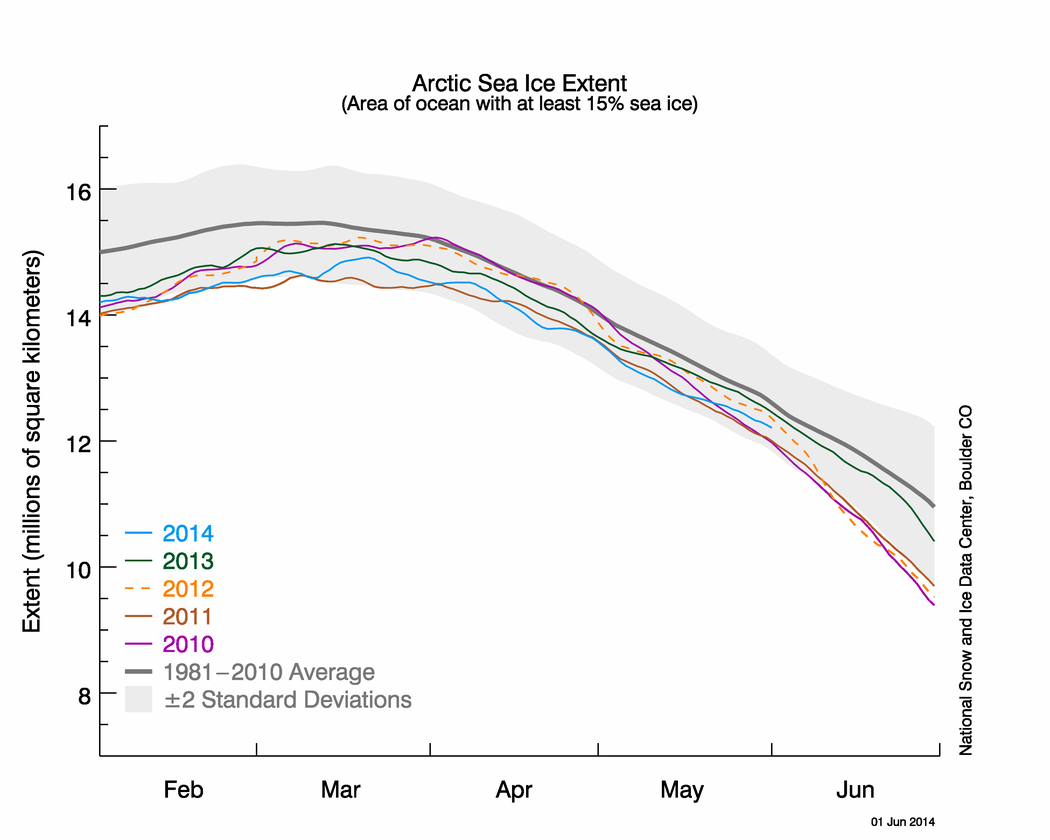
I myself won't take a guess. The Arctic is too fickle and I'm not an expert. Here's the latest chart from NSIDC. Click the image to view larger:
The graph above shows Arctic sea ice extent as of June 1, 2014, along with daily ice extent data for four previous years. 2014 is shown in blue, 2013 in green, 2012 in orange, 2011 in brown, and 2010 in purple. The 1981 to 2010 average is in dark gray. Sea Ice Index data.
Source: NSIDC

I came across a recent paper in Nature Climate Change by David Schröder, Daniel L. Feltham, Daniela Flocco & Michel Tsamados. The authors reckon they've come up with a better approach to predictions - look at the melt-pond area in the spring. The abstract says in part:
...here we show that the Arctic sea-ice minimum can be accurately forecasted from melt-pond area in spring. We find a strong correlation between the spring pond fraction and September sea-ice extent. This is explained by a positive feedback mechanism: more ponds reduce the albedo; a lower albedo causes more melting; more melting increases pond fraction. Our results help explain the acceleration of Arctic sea-ice decrease during the past decade. The inclusion of our new melt-pond model promises to improve the skill of future forecast and climate models in Arctic regions and beyond.

If you want to keep up with the latest in the Arctic, I recommend Neven's Arctic Sea Ice blog.


From the WUWT comments


william's contribution must be a Poe, he says he saw a NOAA documentary called "The Day After Tomorrow":
June 10, 2014 at 9:12 am
Whatever the extent, all of the Polar bears will be drowned and life on our planet will cease when the atlantic conveyor stops and North American temperatures drop to 100 degrees below zero. I saw a documentary put out by NOAA called “The Day After Tomorrow”. Thank goodness our president is going to shut down all the coal plants so that all those people dont freeze to death. There are not enough books to burn to stay warm through something like that!

Jim Hunt offers some good information about Arctic sea ice, but Anthony will have none of it. It's too sciency for Anthony who says that Arctic ice extent has nothing to do with volume:
June 10, 2014 at 9:32 am
Re: @Anthony says: June 10, 2014 at 8:55 am
It’s not my “own views” Anthony. In fact it’s a long list of useful facts and figures for anybody attempting to forecast the future of Arctic sea ice. A long list of useful information still noticeable only by its absence from the WUWT sea ice reference page.
REPLY: We aren’t forecasting volume, we are forecasting extent, so again, your views that we should pay attention to volume graphs on your website (your favorite hobby horse) in this extent forecasting exercise are irrelevant. Don’t clutter up this thread further – Anthony

Anthony really doesn't like scientific comments, it upsets his denier audience. He prefers comments like this one, from Joe Bastardi, award-winning meteorologist and greenhouse effect denier. Joseph Bastardi says (excerpt):
June 10, 2014 at 8:49 am
...One thing is certain. even if it gets NEAR NORMAL given what its been the past 10-15 years since the warm amo really took hold, we can safely say that co2 has nothing to do with this. ...

dbstealey is a Little Ice Age bouncer who keeps contradicting himself trying to cover too many bases while still denying human-caused global warming, and says:
June 10, 2014 at 9:38 am
As we see here, the planet is still recovering from the Little Ice Age. Naturally polar ice is going to decline.
Notice that in the [natural] global warming since the LIA, the trend has remained within its long term parameters. Despite all the alarmist predictions, there has been no acceleration in global warming [in fact, GW has stopped].
If polar ice declines, so what? As with rising CO2, that would be a net benefit: much shorter transit times for shipping, with much reduced fuel costs, an open northwest passage, less need for icebreakers, etc.
The only reason polar ice is discussed is because of the endless predictions that Arctic ice would soon disappear. The alarmist crowd is desperately hoping that it does. But so what if it does? It’s all good… and it’s all natural.

ripshin says it's cold in Virginia so there'll be a lot of ice in the Arctic in September:
June 10, 2014 at 10:18 am
June feels a lot cooler here in central Virginia than it used to…so I’m going with more ice: 7.75 MsqKM. “Today, I go for the gusto.”
rip

Steven Mosher linked to some charts (see third one down for different projections), but Anthony doesn't want to acknowledge the disappearance of Arctic sea ice:
June 10, 2014 at 11:20 am
https://sites.google.com/site/pettitclimategraphs/sea-ice-extent
REPLY:IMHO, any graph that uses “death spiral” as part of the description should be ignored – Anthony


Schröder, David, Daniel L. Feltham, Daniela Flocco, and Michel Tsamados. "September Arctic sea-ice minimum predicted by spring melt-pond fraction." Nature Climate Change (2014). doi:10.1038/nclimate2203

Wednesday, April 2, 2014

We can ignore everything Anthony Watts says because of his denier affiliations

Sou | 8:02 AM Go to the first of 8 comments. Add a comment

Anthony Watts has another "Claim" headline (archived here).  This time it's a claim that Arctic sea ice is forming later and melting sooner - as a general trend.  (Anthony copied and pasted a long article with no attribution for the article and no link to any source. He didn't mention the research paper itself.)  Here are the opening paragraphs from the NASA press release:
The length of the melt season for Arctic sea ice is growing by several days each decade, and an earlier start to the melt season is allowing the Arctic Ocean to absorb enough additional solar radiation in some places to melt as much as four feet of the Arctic ice cap’s thickness, according to a new study by National Snow and Ice Data Center (NSIDC) and NASA researchers.
Arctic sea ice has been in sharp decline during the last four decades. The sea ice cover is shrinking and thinning, making scientists think an ice-free Arctic Ocean during the summer might be reached this century. The seven lowest September sea ice extents in the satellite record have all occurred in the past seven years.
"The Arctic is warming and this is causing the melt season to last longer," said Julienne Stroeve, a senior scientist at NSIDC, Boulder and lead author of the new study, which has been accepted for publication in Geophysical Research Letters. "The lengthening of the melt season is allowing for more of the sun’s energy to get stored in the ocean and increase ice melt during the summer, overall weakening the sea ice cover."

The fact that the melt season is getting longer won't be a surprise to anyone.  However Anthony Watts dismissed the analysis because:
I tend to take research done by Ms. Stroeve with a grain of skepticism, since she allows her work to be aided by political activists at Greenpeace.

Julienne Stroeve
(Image: NSIDC)
Ms Stroeve is Julienne Stroeve PhD.  That is, Dr Stroeve, who is a research scientist with the National Snow and Ice Data Centre (NSIDC) and has an impressive publication history. In 2012 she travelled to the Arctic to do research, which she blogged about.  It's really the research findings that Anthony objects to. His excuse for rejecting it is typically pathetic.

You can read the full paper here (open access at the moment).


Here is Anthony Watts hoping that the greenhouse effect will be disproven one of these days:
While there likely is some truth in the report, what isn’t explored is whether the cause of this change is part of a natural cycle, a natural cycle enhanced by some AGW effects, or purely an artifact of AGW.
Their claim…
The increases in surface ocean temperatures, combined with a warming Arctic atmosphere due to climate change, explain the delayed freeze up in the fall.
…reads like something Greenpeace would write, providing no other possibility. One thing I tend to notice about Earthly geological and atmospheric processes is that they tend to act on timespans than exceed human lifetimes, sometimes being orders of magnitudes longer. In the case of Arctic sea ice, a record going back to 1979 is shorter than that and only represent a fraction of what may be a natural cycle. Making claims that they know exactly what the cause is might very well bite them in a few years or few decades.

What other possibility would Anthony entertain?  Leprechauns? Magic? He thinks that Arctic warming in the context of global warming might be "natural"? That the greenhouse effect has suddenly stopped working?

Notice his "tend to notice" that "Earthly geological and atmospheric processes" act on timespans that exceed human lifetimes.  Sometimes being orders of magnitudes longer!

Wow - really, Anthony?  What a revelation that will be to all the world's geologists.

Yeah. It's a huge ask to expect a science denier to think in timeframes longer than their personal life span.

Since Anthony can take Dr Stroeve's research, and by association anything that comes out of the NSIDC, with his "grain of skepticism", I expect that means he's letting the world know that we can take anything he writes with a huge dollop of disdain.  He has a long association with the ignominious Heartland Institute and gets a lot of his material courtesy of people like the award winning climate disinformer Marc Morano.


From the WUWT comments


Sorry, I'm still strapped for time.  You can read them archived here.  I notice that Anthony is trying to retrieve his shattered reputation. Fat chance, Anthony! And he's playing the persecuted martyr into the bargain.  Cheeky, given his propensity to round up a lynch mob to attack climate scientists and others.


J. C. Stroeve, T. Markus, L. Boisvert, J. Miller, A. Barrett. Changes in Arctic melt season and implications for sea ice loss. Geophysical Research Letters, 2014; 41 (4): 1216 DOI: 10.1002/2013GL058951

Friday, January 17, 2014

Recycling Arctic cyclones at WUWT

Sou | 3:48 PM Go to the first of 2 comments. Add a comment

In my last article I commented how Anthony Watts seemed to have forgotten that he'd already published three articles on Trenberth and Fasullo in the last month, when he put up his fourth article about the paper.

Today he's reposted/recycled another article from last month.  This time about cyclones in the Arctic.   Here are the web archives - December 2013 and January 2014.

Maybe Anthony needs a check up.  I mean forgetting once can be put down to normal human forgetfulness.  Forgetting twice can be put down to not reading the articles he posts.  But forgetting twice in two consecutive days?


More (smaller, short-lived) cyclones than previously thought


Anyway, (if I recall correctly - ha ha) I didn't write about it back in December so here's a summary, based on this article at ScienceDaily.com.  The article was about findings presented at AGU13:
From 2000 to 2010, about 1,900 cyclones churned across the top of the world each year, leaving warm water and air in their wakes -- and melting sea ice in the Arctic Ocean.
That's about 40 percent more than previously thought, according to a new analysis of these Arctic storms.
A 40 percent difference in the number of cyclones could be important to anyone who lives north of 55 degrees latitude -- the area of the study, which includes the northern reaches of Canada, Scandinavia and Russia, along with the state of Alaska.
The finding is also important to researchers who want to get a clear picture of current weather patterns, and a better understanding of potential climate change in the future, explained David Bromwich, professor of geography at The Ohio State University and senior research scientist at the Byrd Polar Research Center.

Anthony previously wrote about the 2012 Arctic cyclone - 27 August 2012 and 19 September 2012 and 24 September 2012 and 27 December 2012 and maybe elsewhere.  In those articles he was implying that the record low summer arctic ice in 2012 could be all blamed on the cyclone.  (In other articles Anthony's posted photos of various ships, misrepresenting where they were and when, in an futile effort to claim that the sharp decline in Arctic sea ice isn't "unusual".)

In these latest articles, Anthony seems to be implying something but I'm not sure what - maybe that Arctic cyclones are causing all the Arctic ice to melt? He wrote:
News media back then seemed to think this was a new thing, and downplayed the role of the cyclone is breaking up sea ice, preferring to attribute it to the omnipotent global warming. Apparently it’s just business as usual for the Arctic.

Still, it's a more rational hypothesis than blaming the Arctic summer ice decline on icebreakers!


Summer is the time for cyclones


Now the thing is that the whole reason that the cyclones weren't easily detected was because they were so small and short-lived, unlike the mammoth cyclone in 2012.  Naturally Neven is right on top of this topic at his Arctic Sea Ice blog.  Neven wrote a number of articles on the big 2012 storm, such as this one.  And in regard to Arctic summer storms in general, here is a quote from an article he referenced last August, here:
“People seem to have this thought that all this storminess is unusual,” said Mark Serreze, an Arctic climatologist and center director at NSIDC. “Well it’s not. It simply isn’t. Summer is the time for cyclones.” Arctic summers are not calm. In fact, the months of August and September see a maximum amount of cyclonic activity. Not every summer is very stormy, but overall, the Arctic is the Arctic for a reason.

So if Anthony Watts and his band of science deniers think that the Arctic is melting purely because of cyclones, that would be wrong.

Anyway, that's enough of that.  Arctic sea ice is Neven's specialty.  His blog is a mine of information and habituated by people who understand and are interested in science.  (Avoid anti-science blogs like WUWT unless you want your brain filled chock-a-block with nonsense.)

Tuesday, November 19, 2013

Last century, the Arctic had the lowest sea ice in the past 646 years

Sou | 8:49 PM Go to the first of 11 comments. Add a comment

Anthony Watts has been keeping a relatively low profile lately.  Oh, he's put up plenty of weird articles such as those by greenhouse effect denier Tim Ball with his wacky conspiracy theories.  But Anthony himself hasn't been jumping in feet first too often in the last few days.  I've noticed more than once recently when he doesn't take much of a stand.  Instead he gives only a slight hint to his readers of the line he expects them to take.  (I guess he's getting weary of people pointing out just how silly he can be.)

Today's article about a temperature reconstruction in the Arctic is an example.  Anthony Watts posts a press release about this paper in PNAS by Jochen Halfar et al.  He provides one clue about how he wants his rabble to react by using the words "hockey stick" in his headline (archived here):
Inverse Underwater Hockey Sticks?
Apart from the headline, Anthony only provides one other little clue to tell his tamed denialati how to behave.  Anthony squeezes the word "claim" into a comment at the bottom of the copied press release (claim is a code word widely used by all and sundry, including HotWhopper, to mean "false claim" as in "that's what they claim, ahem".)  Anthony copies the following from PNAS, but prefaces it with his "They claim":
Significance
The most concerning example of ongoing climate change is the rapid Arctic sea-ice retreat. While just a few years ago ice-free Arctic summers were expected by the end of this century, current models predict this to happen by 2030. This shows that our understanding of rapid changes in the cryosphere is limited, which is largely due to a lack of long-term observations. Newly discovered long-lived algae growing on the Arctic seafloor and forming tree-ring–like growth bands in a hard, calcified crust have recorded centuries of sea-ice history. The algae show that, while fast short-term changes have occurred in the past, the 20th century exhibited the lowest sea-ice cover in the past 646 years.
From the above text, you are probably getting an inkling of what the researchers did and what they found.

The algae in question is called Clathromorphum compactum and can live for more than a thousand years.  The analysis can be compared to using tree rings to obtain information about past climatic conditions.  Here are some excerpts from the University of Toronto press release:
Almost 650 years of annual change in sea-ice cover can been seen in the calcite crust growth layers of seafloor algae, says a new study from the University of Toronto Mississauga (UTM).
“This is the first time coralline algae have been used to track changes in Arctic sea ice,” says Jochen Halfar, an associate professor in UTM’s Department of Chemical and Physical Sciences. “We found the algal record shows a dramatic decrease in ice cover over the last 150 years.”
With colleagues from the Smithsonian Institution, Germany and Newfoundland, Halfar collected and analyzed samples of the alga Clathromorphum compactum. This long-lived plant species forms thick rock-like calcite crusts on the seafloor in shallow waters 15 to 17 metres deep. It is widely distributed in the Arctic and sub-Arctic Oceans.
Divers retrieved the specimens from near-freezing seawater during several research cruises led by Walter Adey from the Smithsonian.
The algae’s growth rates depend on the temperature of the water and the light they receive. As snow-covered sea ice accumulates on the water over the algae, it turns the sea floor dark and cold, stopping the plants’ growth. When the sea ice melts in the warm months, the algae resume growing their calcified crusts.
This continuous cycle of dormancy and growth results in visible layers that can be used to determine the length of time the algae were able to grow each year during the ice-free season.
You can read more here at the University of Toronto.


From the WUWT comments

The article generated quite a few comments.  Below is a sample (archived here).

milodonharlani has an awful lot to say in the comments.  In his first contribution he decides that he likes this paper because it mentions the Little Ice Age.  But it doesn't mean what he thinks it means.  He says:
November 18, 2013 at 5:51 pm
Great to have some actual climate science practiced & published now & then.
As expected, the Little Ice Age had already begun by the 1360s, & Arctic ice cover has decreased during the past 150 years, as climate recovered from the LIA, which ended around 1860, after double bottoming during the sunspot Minima of Maunder c. 1645-1715 & Dalton c. 1790-1830.
Just the normal fluctuations of the Holocene, although with a disturbing longer-term (millennial scale) downtrend.

John, for some unknown reason thinks that Michael Mann doesn't accept the Little Ice Age when in fact he's contributed a lot to the world's understanding of it - for example see here and here.  And John would be very much mistaken if he thought this Arctic study in any way refuted the shape of the hockey stick.  He says:
November 18, 2013 at 5:58 pm
Once again, someone tell Michael Mann that the Little Ice Age really existed.
Too bad the mainstream media, when the pick up on a study like this, refuse to examine how it relates to the iconic hockey stick.

Janice Moore leaves her god out of it for a change and wails and shouts:
November 18, 2013 at 6:03 pm
A bona fide question from a non-scientist:
Re: “Longer periods of open and warm water result in a higher amount of algal magnesium.” (emphasis mine)
How do they know that the controlling variable is not the temperature of the water? How do they know that sea ice extent (i.e., amount of light) is a significant causation?
Isn’t a parallel (and erroneous) assumption commonly made about the controlling cause of tree ring width?
In other words….
How does this study prove ANYTHING?
(A kind soul later pointed out to Janice Moore some facts about photosynthesis.)


lowercasefred says "it's soot!":
November 18, 2013 at 6:45 pm
Q: How do they know the decreased ice cover is the result of climate warming instead of soot?
A: They don’t.

Manfred is happy enough with the research paper.  He's a greenhouse effect denier and would be happy with anything as long as "it's not CO2".  Manfred says:
November 18, 2013 at 7:55 pm
Another study matching well with either the sun or black carbon and not so well with CO2 as the main drivers in the Arctic.

Katherine is one who doesn't like unqualified "unprecedenteds", even when they are qualified in a time context and says:
November 18, 2013 at 7:58 pm
Their proxy covers less than 650 years and they have the gall to use “unprecedented”?! What idiots.

Appropriately named Mushroom George thinks the same algae must live in the southern oceans.  I doubt it, George.  In any case the seas around Antarctica tend to be free of ice in summer.  Mushroom George says:
November 18, 2013 at 8:07 pm
Recently, sea ice area increases in Antarctica seem to balance out most of the sea ice decreases in Uncle arctica. I would like to see algal growth rates from both poles compared.

Dr. Bob didn't bother reading the article but still says "scientists don't know nuffin'":
November 18, 2013 at 8:23 pm
Is there any data supporting the hypothesis that growth rings are directly proportional to temperature, sunlight penetration or maybe perhaps dissolved CO2. Unless you can prove that growth rings are proportional in width to some factor, it is hard to say anything about these data. It seems to me that people take for granted proportionality when they don’t have proof of concept.

I've run out of puff and can't be bothered reading any more comments.  You can read them archived here if you want to.  A few people are showing signs that their brain hasn't completely atrophied, but some those same people seem to think the scientists have no brains at all.


A little bonus for sticking through to the end

I'll leave you with a bonus.  There was a rather strange diversion in the comment thread, right into creationism.  Since it's been slow at WUWT lately, I'll copy it here.  Always good to read one ratbag science denier arguing with another ratbag science denier to see which is the bigger ratbag.  By the way - I think Stephen Meyer and David Berlinski must be creationists of one form or another :)

Janice Moore says (excerpt):
November 18, 2013 at 7:38 pm
Dear Milodon Harlani,
Have you ever watched the videos I linked? Every time I ask that, you do not answer. Did you think I did not notice? I think that, if you look into it, you will find that Dr. Stephen Meyer’s and Dr. David Berlinski’s credentials provide an excellent basis for their scholarship.
You accuse me of not learning, but you refuse to watch the lectures I posted (I only re-posted them because from your remarks, it was pretty clear that you had not watched them). How do you know that they are not well-reasoned and persuasive without listening to them?

milodonharlani says (excerpt):
November 18, 2013 at 7:54 pm
I don’t need to look into it, Janice Moore, because I’m thoroughly familiar with their total lack of credentials. They practically no knowledge of biology, except just enough to know that they are lying shamelessly, but don’t care, because they’re paid to hoodwink suckers like you. I’ve listened to their pack of lies for over a decade. To call their mendacity “scholarship” is the deepest possible insult to every scholar who has ever lived.
I don’t refuse to listen to your pathetic videos. I’ve heard them & talked to them in person. They’re paid liars, plain & simple.
I’m not the least bit in danger. It is you whose soul is in mortal danger. Your heroes are liars against the God of creation, Janine Moore. I pray you learn that before it’s too late.
God has revealed Himself to me through His creation. His Works in creating the universe(s) take precedence over your satanic, bibliolatrous, blasphemous interpretation of His Word. Wake up! You’ve been sold a bill of dangerous goods. Learn actual science instead of false religion. Worship the Creator & not a book written by men (& maybe one woman) trying to grasp the Infinite.


J Halfar et al (2013); Arctic sea-ice decline archived by multicentury annual-resolution record from crustose coralline algal proxydoi: 10.1073/pnas.1313775110 

Sunday, September 8, 2013

David Rose and his tabloid "reporting" of Arctic sea ice and other nonsense

Sou | 9:02 PM Go to the first of 26 comments. Add a comment

UPDATE 3 15 Sept 13: David Rose has written another error-ridden article before taking the time to correct the errors in this one - read about it here.

UPDATE 2: See below for a Press Release from the IPCC confirming that David Rose was wrong.  The IPCC is holding its scheduled meeting at the end of the month.  There are no other meetings scheduled.


UPDATE: David Rose apparently also writes as "Hayley Dixon" for the UK Telegraph?? (Not really.)  A more subdued look and feel (compare with the Mail Online here) but the same lies and disinformation. (h/t Ed Hawkins via twitter.)


David Rose is a so-called journalist in the UK.  One of his specialities is disinformation about climate and climate science.  He writes for a tabloid in the UK, maybe one rung up from what is affectionately known as the gutter press.  You know the type - boobs, scout master "scandals", UFO's and other sensationalist crap to titillate the hoi polloi.  The Mail is maybe a smidgen above that, maybe.  Tabloids are not considered serious newspapers and have very little to do with news. To illustrate the content and target audience, here is a list of the most-read items as listed on the Mail Online today, in order:
  1. The daughter of a radio "breakfast host" gets married
  2. A pregnant woman on Big Brother, a very lowbrow reality tv show
  3. The UK Prime Minister attends a family wedding
  4. An internet harasser who said he got death threats
  5. A television "celebrity" faints
  6. Sensationalist scare stories about Pakistan, water and the Euro (Yeah, I know!)
  7. A member of the British royal family is "spotted" on a yacht

The list might change before readers get to it, but I expect every list is similar.  That sets the scene nicely for this semi-fictional sensationalist nonsense from a David Rose, who has a history of making up stuff about climate as documented here and here and here and here and here  and here  and here (shall I continue?).

David Rose's headline this time is utterly ridiculous (see here - archive sites are still not working).  He writes: "Record return of Arctic ice cap".  Never mind that the sea ice in the Arctic is the fifth or sixth lowest extent on record.  He says that according to "eminent" scientists the world is about to plunge into a cooling period that will last till the middle of this century.  He's another denier who is nutty as a fruit cake and is pandering to an audience who are as ignorant about climate as anyone could be - maybe with the exception of the deniers who read WUWT and similar silly anti-science blogs for a hobby.

David doesn't say who all these "eminent" scientists are (he quotes one below but no others).  He does quote a years old report of Professor Maslowski (from 2007), but neglects to let his readers know that projection has since been revised.  Nor that few scientists would agree with the revised projection made in 2011  (2016 plus or minus three years).  From the same BBC 2011 article: 
...one peer - Dr Walt Meier from the US National Snow and Ice Data Center in Boulder, Colorado - said the behaviour of sea ice becomes less predictable as it gets thinner.  "[Maslowski's] is quite a good model, one thing it has is really high resolution, it can capture details that are lost in global climate models," he said. "But 2019 is only eight years away; there's been modelling showing that [likely dates are around] 2040/50, and I'd still lean towards that.  "I'd be very surprised if it's 2013 - I wouldn't be totally surprised if it's 2019."
And in this 2012 paper, Maslowski et al write about Arctic sea ice, including various projections and state, in reference to one of them:
Given the estimated trend and the volume estimate for October–November of 2007 at less than 9,000 km3 (Kwok et al. 2009), one can project that at this rate it would take only 9 more years or until 2016 ± 3 years to reach a nearly ice-free Arctic Ocean in summer. Regardless of high uncertainty associated with such an estimate, it does provide a lower bound of the time range for projections of seasonal sea ice cover. (We do note that other published estimates also have large or indeterminate uncertainties.) At the same time, observational proxies of ice thickness (Maslanik et al. 2011) and independent model estimates (Polar Science Center 2011) of sea ice volume suggest a further decline of ice volume since 2007.
So Maslowski is talking about a lower bound, not making an absolute prediction.  Deniers like Anthony Watts and David Rose won't tell you that.  Would they even have bothered to check?

David Rose reckons he nabbed a quote from Judith Curry but you can't take him at his word.  This quote isn't about Arctic ice, though.  It's about Judith's favourite subject - doubt.  Judith is getting nuttier day by day, so I wouldn't be surprised if she said to David that: "In fact, the uncertainty is getting bigger. It’s now clear the models are way too sensitive to carbon dioxide. I cannot see any basis for the IPCC increasing its confidence level."  She has nothing on which to base that claim.  But Judith does like to shout "uncertain" as often as she can.  She's an avowed delayer wanting to wait till the earth boils before doing anything to mitigate global warming.

David adds a quote from Professor Anastasios Tsonis, of the University of Wisconsin, with David claiming (falsely of course) that he was one of the first to investigate the ocean cycles. ( Ocean cycles have been investigated since at least early last century, long before Tsonis was born.)  According to David Rose, Professor Tsonis said: ‘We are already in a cooling trend, which I think will continue for the next 15 years at least. There is no doubt the warming of the 1980s and 1990s has stopped.'  Whether he did say that or not I don't know.  But even if he did make that contrarian claim, one scientist is not enough to claim "eminent scientists" think the earth is about to turn cold. Nor is 2013 plus 15 years equal to 2050.
Then David tells a big fat lie and writes: "The continuing furore caused by The Mail on Sunday’s revelations – which will now be amplified by the return of the Arctic ice sheet – has forced the UN’s climate change body to hold a crisis meeting."  Actually that's three lies:
  1. The Mail on Sunday didn't make any revelations, it is in the disinformation business, not the information business.  (Refer links above to David Rose's history of peddling lies about climate.)
  2. The Arctic ice sheet has not 'returned' in the manner that David would have you believe.  The Arctic "ice sheet" that David refers to is not an "ice sheet", it's sea ice and is on a rapidly declining trend.  It is shrinking not growing.  See my previous article for more info.
  3. The UN climate change body that David refers to would be the IPCC.  It is not to my knowledge holding any crisis meeting.  I expect David is referring to the long-scheduled meeting to consider the final draft of WG1.  The 36th session of the IPCC is scheduled to take place in Stockholm from the 23 to 26 September.  It would most likely have been in the IPCC calendar for years.
I see that Ed Hawkins says he told David Rose that the IPCC was NOT having a crisis meeting in Stockholm.  But what does David Rose care about the facts.

Why does David Rose tell lies to his readers?  Who can guess.  Maybe it's to try to hang onto his job, though why that's of any value to him I cannot imagine.  

I'm trying to imagine how much status his job gives him.  It would be quite a conversation stopper.  "What do you do, David?"  "Oh, I make up fantastic lies about climate change for a sensationalist tabloid in the UK".  Ummm... yeah, right.

Update: It's been suggested I post a picture.  Here is one I put together for an article a couple of days ago (which has some more besides). It's an animated gif comparing Arctic sea ice on 5 September 1980 with that on 5 September 2013 - big difference:

Source: Cryosphere Today
Also, since writing this there are very good criticisms of the Mail and Telegraph pieces by Dana Nuccutelli in his UK Guardian blog and by Phil Plait of Bad Astronomy at Slate as well as some thoughts from Catmando of Ingenious Pursuits and some tongue-in-cheek commentary on the Greenpeace UK climate blog.


Update 2 Press Release from the IPCC


GENEVA, 11 September - In response to recent articles about forthcoming meetings of the Intergovernmental Panel on Climate Change, the IPCC would like to note that:

Contrary to the articles the IPCC is not holding any crisis meeting. The IPCC will convene a plenary session to finalize the Working Group I contribution to the IPCC's Fifth Assessment Report, in line with its normal procedures, in Stockholm on 23-26 September 2013. The session has been scheduled for several years and this timetable has been repeatedly publicized by the IPCC.

As part of the IPCC's regular procedures, member governments were invited to comment on the final draft of the Summary for Policymakers of the Working Group I report ahead of the Stockholm meeting. Over 1,800 comments were received - a typical number for this exercise - and they will be considered as planned at the meeting in Stockholm. The Summary for Policymakers is due to be released on 27 September 2013. The accepted Final Draft of the full Working Group I report, comprising the Technical Summary, 14 Chapters and three Annexes, will also be released online in unedited form, on Monday 30 September. Following copy-editing, layout, final checks for errors the full Working Group I report “Climate Change 2013: The Physical Science Basis”, and its Summary for Policymakers will be published online in January 2014 (tbc) and in book form by Cambridge University Press a few months later.

Click here for the press release.


Thanks to Anonymous for the link to this latest atrocious piece of disinformation from David Rose and the Mail Online.  Whats the bet it will soon appear on Anthony Watts science denying blog, WUWT?

Denier weirdness - On WUWT it's Arctic ice-breakers causing global warming!

Sou | 2:29 PM Go to the first of 3 comments. Add a comment

Anthony Watts has posted an article by one of his regular guest authors, justhefactswuwt (archived here).

The article goes on about how the sea ice isn't declining to a new record minimum this year, as if that means that global warming is at an end or some such nonsense.  And that Antarctic sea ice has been above the maxima this winter, as if ice in winter means global warming isn't happening.

The following charts give you an idea of what has been happening to the sea ice in the Arctic over the past few years and decades.  Click images to enlarge them.

This first chart shows the change from 1979 to now.  It's a very disturbing trend.  The Arctic sea ice all year around has had a huge decline.  It's not just summer sea ice that's declining, though that's arguably the most dramatic ice loss.

Source: Cryosphere Today

This chart only shows from 2002 to 2013.  Even just this decade the sea ice extent in summer has declined to a remarkable degree.
Source: JAXA

This next one shows the stark difference between sea ice in early September 1980 and that of the same day this year.
Source: Cryosphere Today

The WUWT guest writer and WUWT readers are oblivious to the fact that the Arctic summer sea ice is the fifth or sixth lowest it's ever been in recorded history. It's lower than all but one year (2007) or maybe two years (2007 and 2009) of the first decade this century, though not as low as 2011 or the record low of last year, 2012.


Ice breakers in the Arctic are causing global warming!


One sadly hilarious lot of comments from justthefacts and several other people is that they speculate that ice breakers are causing the Arctic sea ice to decline.  Seriously.  They are suggesting that a ship that breaks up a path through ice so that they or ships behind them can make it through are responsible for the melt of an additional two to three million square kilometers of ice in summer.  It's true.  Here are some comments (archived here) so you can read for yourself just how ignorant is the audience that Anthony Watts, denier blogger, aims for:

Eve says:
September 7, 2013 at 4:27 pm
Loved that US sailer on a boat in the Arctic saying the Canadian government should learn good PR and provide gratis Icebeaking service. I wonder how much ice breakers have contributed to the “soon to be ice free Arctic”? There are Russian and Canadian icebreakers out there now breaking up the ice.

noaaprogrammer says:
September 7, 2013 at 6:08 pm
Eve wrote: “I wonder how much ice breakers have contributed to the ‘soon to be ice free Arctic?’ There are Russian and Canadian icebreakers out there now breaking up the ice.”
By so doing, they’re allowing more ocean heat to escape into the atmosphere and space.


justthefactswuwt thinks it "measurable but not major" and says there are 110 ice breakers in the entire world.  He says (excerpt):
September 7, 2013 at 6:46 pm
Eve says: September 7, 2013 at 4:27 pm I wonder how much ice breakers have contributed to the “soon to be ice free Arctic”?
I have not seen any substantive research on the subject, thus cannot answer with any confidence. However, if I had to guess, I’d say measurable, but not major. 


Some of the WUWT commenters appear to be finally coming to the realisation that an ice free Arctic is not a good thing.  When WUWT-ers suggest that Neven and others who report on the subject are happy about it (are WUWT-ers insane?  Yep, or verging on the irrational at least), there are a few comments like this one from Kevin Ryan who says:
September 7, 2013 at 6:57 pm
“Next year will probably be better.” – Neven
If that means what I think it means then what the heck is wrong with some people. Hoping for bad things to happen. Imagine someone saying, “Well your cancer is in remission, but next year will probably be better and it’ll come back.”
No, Kevin.  If you ever visited Neven's excellent sea ice blog you'd know very well it doesn't mean what you think it means.  But it's good that you realise that the disappearance of Arctic summer sea ice is a disaster of major proportions.


Other WUWT-ers are still in deep denial. Josh M talks about "fictitious runaway global warming", he is very confused about what the science says (it's neither fictitious nor runaway):
September 7, 2013 at 7:48 pm
Anyone dumb enough to extrapolate an exponential trend from a chaotic natural process shouldn’t be running a science blog. It’s quite clear that variation in arctic ice extent can be largely ascribed to wind patterns (+ – dipole anomalies) and oceanic cycles such as the PDO and AMO rather than some sort of fictitious runaway global warming.

BarryW isn't aware that Arctic sea ice extent is way, way below what it used to be and is declining much more quickly than scientists had projected.  He says:
September 7, 2013 at 5:21 pm
The warmist’s are no different than any other cult that believes the “End of the World” is nigh. Even when the signs they predict don’t happen, they just push the date out and rationalize why the sign didn’t appear. Their frustration is that though they are sure they are right regardless, the sign was to convince the unbelievers of their revealed TRUTH.
Update: Smokey aka dbstealey proves the points I made in my latest blog article and is even deluded enough to claim that Arctic sea ice is "completely normal".  He combines the scaredy cat delusion with his anti-social lack of values and says:
September 7, 2013 at 8:51 pm
Jeff Allen says: “I’ll also say ‘shame on you’ to Anthony for taking quotes on Neven’s blog out of context.”
Relax, Jeffy. The world is not ending. Arctic ice is going through its normal cycle. There is nothing to be concerned about. Nothing at all. But they have you all scared, which is what they want.
The Chicken Little [U.S.] / Chicken Licken [U.K.] brigade has you all frightened. That is their intention, and you fell for it. Now, open your wallet. Wide. Then you will feel much better!
The fact is that global ice cover is completely normal. There is nothing either unusual or unprecedented about what you see. It has all happened before, and to a much greater extent.
So don’t let the scary people make you pucker up. Their reason is to separate you from more of your tax money, nothing else. You need to be able to discern motives, or you will just be their chump. You don’t want that, do you?

It truly is the 8% dismissives that Anthony Watts sells his wacky ideas to.  These days he doesn't bother to aim for an audience of rational, informed people.  He's targeting the scientific illiterati and hitting the bullseye.