.
Showing posts with label wattsupwiththat. Show all posts

Wednesday, January 27, 2021

Everything climate disinformation from the climate conspiracy-theorists at WattsUpWithThat

Sou | 2:19 PM Go to the first of 11 comments. Add a comment

Anthony Watts has set up a new website for climate disinformers and wilful deniers. (H/t CJ in the comments here at HotWhopper.)

His disinformation website is called Everything Climate. Translating its stated aim from denier-speak, it is to hook people who aren't yet knowledgeable about climate to recruit them as conspiracy theorists for the climate disinformation cult.


Questionable claims from the outset

Anthony Watts is known in climate science denier circles as a climate science disinformer and conspiracy theorist. True to form, he made a number of questionable claims in his introductory article. He wrote "We have four categories at the moment, and a few dozen sub-titles covering specific claims/arguments that are commonly in the news and are contentious."  The bit about "a few dozen sub-titles" is weird, because I can only see 23 articles. I've no idea what the "few dozen sub-titles" relate to. As for the topics he claims are all contentious, some of them are so well-established they are indisputable, some are the topic of active scientific research, and some are strawmen (i.e. the Everything Climate topic is not a claim or argument in scientific circles).

Monday, July 30, 2018

Watts up with that vs Google vs Climate Change

Sou | 12:26 AM Go to the first of 19 comments. Add a comment
There's consternation at the climate conspiracy blog WattsUpWithThat.com (WUWT). Kip Hansen, a random denier dude, is ropeable. He's most upset because, in June this year, WUWT had a big drop in click-throughs from Google. A 30% drop, according to Kip (Google cache here :D).

Now this isn't about paid-for click-throughs (via Google AdWords). It's just about the freebie service that everyone gets. Here's his evidence that the Google algorithm is working better. Feel free to celebrate or commiserate.

Chart source: Wattsupwiththat.com

You probably noticed that, as climate science deniers tend to do with temperature charts, Kip's 30% measurement started at an unusually high point. (He may not have been able to get much earlier data because WUWT moved to a new server at the end of May this year and Anthony Watts might not have kept stats the same way on the old server. Who knows?)

Sunday, March 16, 2014

Anthony Watts falls in love with Alexa rankings - and bounces

Sou | 1:58 PM Go to the first of 11 comments. Add a comment

For a fake sceptic who is constantly disputing numbers that have been provided by observers, checked by analysts, verified by scientists and fit with the theories - Anthony Watts is remarkably accepting of numbers that he likes, even though few if any experts in that field pay them any mind.

I'm talking about Anthony's love affair with Alexa. No, it's not a woman it's a webstats service now owned by Amazon.com.


More than 40% of WUWT visitors don't bother to read a full WUWT article!


Today Anthony has put up another chart, this time boasting of his bounce rate (archived here).  The bounce rate is the proportion of readers who visit a site without clicking through to another webpage on the same site.

Let me point out that to read an entire article on WUWT requires at least one extra click.  So if WUWT had a bounce rate of 40.90%, that means that 40.90% of his visitors don't even read one whole article.

On the other hand, a site like this one shows the most recent seven articles that you can read in full without clicking through once.  So if there was a bounce rate of 18.60% that would mean that even though readers could read seven articles in full and still be counted as a "bounce", 81.40% of visitors want more than just those seven articles.  That's assuming Alexa was close to being accurate.

[Correction: This assumes that everyone first arrives at WUWT and HotWhopper by landing on the home page, which ain't necessarily so as Collin points out below - he is such a spoil sport :D. Some people will arrive via a Google link to a specific article and some will get directly to an article by a link from Twitter or elsewhere.]

So let's see how they compare, according to Anthony's trusted Alexa.  HotWhopper's is archived here and WUWT is archived here:


Hmmm....WUWT's bounce rate doesn't look so good now, does it :)

BTW - for some weird reason, Alexa.com has always shown HotWhopper with an unbelievably low bounce rate.  On Google Analytics the bounce rate is quite respectable - varying each month between 55% and the low 60%s. That number can't be compared with the Alexa bounce rate but I figure it's pretty good. Particularly when more than 3/4 of visits are from people who've visited before so they are probably just catching up with recent articles and don't need to click through.  Here's a discussion of bounce rates.


Cherry-picking bounces


As an aside, when the Scottish Sceptic put up a web ranking, Anthony's second comment and his only request AFAIK, was to ask him to include yours truly or, as Anthony put it the lunatic fringe blog known as “hotwhopper".

In this latest article on WUWT, HotWhopper is noticeable for its absence.  Now why would that be, I wonder?  Surely Anthony isn't just limiting his list to websites with a higher bounce rate than WUWT! Talk about cherry-picking!

Given that Anthony seems to have left a few sites off his little list, lets add some back. Wunderground.com, with it's brilliant blogs has an Alexa rank of 606 - Anthony's blog isn't in the same league so I can understand why he left that off the list.  It's got a decent bounce rate too.  A bit better than WUWT at 39.4%.

Thinkprogress.org, which hosts climateprogress has an Alexa rank of 4184, a lot better than WUWT so I can understand why Anthony left that off the list, too, even though it's bounce rate is higher than that shown for WUWT.


Quality vs quantity


Anthony has to work hard to "compete" against real climate science websites, like realclimate.org, which despite only posting a few articles a month has maintained a strong web presence for many, many years.  Anthony has to put up at least three silly articles a day to attract his visitors.  Quantity wins over quality every time with the illiterati.  I notice that in the comments, someone unkindly drew attention to the fact that most WUWT readers, according to Alexa.com, don't rate highly education-wise.

Skepticalscience.com also continues to impress and doesn't have to put up three or more shoddy articles a day to attract a lot of visitors.  It has a respectable Alexa.com ranking FWIW and, though it has a higher bounce rate according to Alexa.com, it's articles are based on science (unlike WUWT) with hyperlinks to lots more information.

I've written before about how people who want to read about climate science have a zillion more choices than science deniers who want to read about pseudo-science.  So the number of hits on any pseudo-science or anti-science blog like WUWT would be barely a blip when compared to all the hits on science and climate science websites.


How to improve your Alexa ranking


One good way to improve your Alexa ranking, if it's important to you, is to write a blog article called "How to improve your Alexa ranking" - and/or get readers to install the Alexa toolbar, spyware and all, and then plead with them to visit your blog!

When Anthony Watts urged all his followers to install the Alexa toolbar last May, his rank suddenly improved a whole lot - going from a global rank of 30,000 to around 20,000 almost overnight and another 10,000 in a matter of weeks.  You can see this clearly in his Alexa web stats (archived here for posterity)


It's not as if Anthony needs to do this sort of thing to fake a jump in his readership.  His blog is very popular and gets lots of hits every day.  As he later found, his blog is right up there in popularity among wordpress blogs.  It's not just the 8% dismissives who go there, even normal people visit WUWT to see what the wacky deniers and climate conspiracy theorists and other utter nutters are up to.

Update: Last year, Victor Venema did an analysis showing that the uptick in WUWT's readership in May last year wasn't real.  It only showed up in Alexa, not any other webstat measure, and can therefore be attributed to Anthony's toolbar request.


From the master webmasters: Alexa is unreliable


Alexa isn't reliable for web stats.  What it does is measure the traffic of people who have the Alexa toolbar installed.  This is what Paul Stamatiou, designer at Twitter, wrote about Alexa rankings back in 2007, showing the big difference in Alexa rankings between two sites that had similar numbers of visitors.
John mentioned in a recent post that he received 266,641 page views from 127,614 unique visitors during the month of February. For February, I received 227,852 page views from 136,064 unique visitors. Does the Alexa graph below show that?
Source: Paul Stamatiou of Twitter


This is what people on the "#1 internet marketing forum since 1997", Warrior Forum, say about Alexa - and more here.  And this from one of the WarriorForum gurus. Anthony - eat your heart out. Warrior Forum has a global rank of 215 on Alexa :) (Lower is better.)


This is from another SEO blogger (SEO=search engine optimisation):
Besides the obvious issue that your rankings will be based only on those who actively participate with Alexa, there is also the issue that your competitors (or you) can easily purchase hits for Alexa for just a few dollars. I saw an ad on Fiverr offering to let people buy hits in packages of about 10,000 or so for Alexa to build rankings.

EricHammer could very well have had the WUWT herd in mind when he wrote that article. He goes on to write that Alexa ranking is "helpful" because of the "herd mentality issue":
No – I wouldn’t say Alexa is useless. It’s just not a very accurate measure of your site’s popularity amongst the Internet elite of the world. It is helpful to put up a high Alexa ranking because of the herd mentality issue – people like to visit sites they think are popular. So when you have a high Alexa ranking, they think your site is worth something.

Yes, that's right. If you want to boost your Alexa rankings, you can always pay for it. (I've got better things to spend my hard-earned money on.)

Climate blogger, Collin Maessen, wrote about this last year, with a follow up post using yours truly as an example just a few weeks ago.  (Collin works in IT I think, so he knows about such things.)


How to improve your Alexa ranking


After Collin's article and my mysterious drop in Alexa rankings even though Google Analytics showed HotWhopper was getting more readers by the week, I did a little experiment - I soon varied it from the experiment I wrote about here.  I installed the Alexa toolbar on a browser that I don't normally use and made sure I visited HotWhopper every day and opened a few pages.

This is what happened:


Alexa.com dropped my ranking while Google showed no particular change.  The Alexa ranking then dropped hugely  for no reason around the end of January, while Google Analytics was showing a big jump in visitors from December.

It was at this point that I installed the Alexa toolbar and opened a few HotWhopper pages every day.  You can see the results above.  The Alexa ranking for HotWhopper immediately stopped falling and started to improve again, quite markedly.

Now it might not be just my tiny number of clicks each day that caused the ranking to go back to what it was in October last year, but it's a mighty big coincidence.  The other thing is that visits to HW are quite a bit higher than they were back in October last year - so who knows what Alexa ranking HW will end up with, though it does look to be tapering off :)


A better comparison


I don't know if Anthony Watts is looking to sell his website or get more advertising revenue or if he is just looking for pats on the back.  Whatever, he's deluding himself if he's relying on Alexa rankings to compare his website with other climate websites.  It would be interesting if he used another comparison, like comparing how climate scientists rate his website alongside that of, say, realclimate.org or skepticalscience.com.  I have a feeling it would look something like this.


Sunday, September 22, 2013

Denier weirdness: Anthony Watts walks on water in NYC after the seas have risen

Sou | 2:01 AM Go to the first of 8 comments. Add a comment

More denier weirdness.  Anthony Watts, denier blogger at WUWT, found two photos of New York City that he seems to think proves that rising sea levels are nothing to worry about (archived here). The top one he thinks was probably taken around 1930 and the lower one was taken in 2010 (click to enlarge).

Credit: Fairchild Aerial Surveys Inc.
Source: NOAA

Credit: Gryffindor
Source: Wikipedia

Anthony is on a sea level denial kick with two articles in as many days.  He writes:
While there have been a lot of changes, most notably the mature trees now in Battery Park, one thing is clear – the city has not been inundated by sea level rise even though the NOAA Battery Park tide gauge indicates a rise of about 0.22 meter ( 8 3/4 inches)...
... As always, I remind our readers: Freaking out about NYC sea level rise is easy to do when you don’t pay attention to history
That's good to know.  New York City is 22 cm closer to flooding than it was 80 years ago.  Is Anthony trying to argue that because Battery Park isn't permanently under water yet, that means that New York City will be okay forever?  When seas rise by another meter later this century or early in the next, or when when seas rise by several meters over the next few centuries - well, I guess Anthony and his readers won't be around at the end of this century so that might explain his lack of concern.

I reckon his article comes under the category of denier weirdness.  Is this what "okay" looks like?

FDR Drive, flooded by Hurricane Sandy, October 29, 2012
BuzzFeed

When seas rise half a metre, the edges of lower Manhattan will flood 20 times a year


As the ice melts, seas could be a metre higher within 80 or 90 years - or up to twice that.  From The Wall Street Journal (the New York financial district is one of the areas most at risk) - the future is now and it will get worse as sea levels rise:
While most of New York is above sea level, its subways, telecommunications cables, fiber-optics networks, plumbing and power mains aren't. "There is so much underground," says urban water management consultant Piet Dircke at Arcadis, one of four engineering firms that recently developed concepts for a storm surge barrier here. "The economic impact of flooding could be huge."...
...Under certain conditions, a hurricane now could generate a 30-foot-high storm surge and flood 100 square miles of New York. If ice melts and sea level rises, that risk increases. "If you have 20 inches (0.5 m) of sea level rise, the edges of lower Manhattan would flood 20 times a year," says Douglas Hill, a consulting engineer at the School of Marine and Atmospheric Sciences at Stony Brook University. "It would look like Venice."
Read the full article here.

Click here for a map of how rising seas will affect New York City.  You can choose different levels.


From the WUWT comments

Different people react differently - but not many WUWT-ers are denying outright that New York could be in trouble.  Click here for the archived article and comments.

Greg Goodman says:
September 21, 2013 at 8:05 am
Ya gotta admit the water does kinda look higher ;)

johnmarshall says:
September 21, 2013 at 8:16 am
Comparing those two photographs above it looks like a small sea level fall. There has been some reclamation round Battery Park in the mean time which might confuse the issue but nothing alarming with sea levels.

Darren Potter says:
September 21, 2013 at 8:35 am
Sea level isn’t rising, instead tide gauge is sinking do to anthropological expansion / construction. Which resulted in land subsiding under weight of the numerous and massive buildings crammed full of people.  Setting aside the sinking… The air sure looks a whole lot cleaner now than it did back in 1930s. Appears that increasing CO2 ppm, results in less Smog.

Jimbo says:
September 21, 2013 at 8:35 am
As one commenter mentioned on the other Battery Park thread much of Manhattan is reclaimed land. They asked what effect does millions of tonnes of steel, concrete and other human structures have on subsidence? (I paraphrase.)

Saturday, September 21, 2013

More WUWT denier weirdness:- Monckton's 8% Dismissives plus another glimpse into "mad, mad, mad" Steve Goreham's world

Sou | 4:04 PM Go to the first of 9 comments. Add a comment

Today at Anthony Watts' denier blog, wattsupwiththat (WUWT), Anthony provides two more examples of denier weirdness.

Monckton highlights the 8% Dismissives


Christopher Monckton doesn't like the scientific consensus that humans are warming the world.  He's taken a particular dislike to Cook et al (2013), which is the most recent of several papers that demonstrate how great is the consensus. (97% of papers that attribute a cause to global warming attribute it to human activity.)

So he's decided to write a letter to the editor of the journal that published Cook13 - ERL.  Then he had another idea and has now decided to send a copy to every member of the editorial board of the journal. (See Christopher's original version archived here, and his later version archived here.)

Christopher's said he wants to "crowd-source" signatories so has asked for the help of the readers at Anthony Watts denier blog - wattsupwiththat.com (WUWT).  I was interested in seeing who put their names to the letter.  I reckon what he's done is highlight the difference between the denier commenters.  The couple of hundred people who want their names on Christopher's silly letter are the 8% Dismissives.  People like "shouty" Richardscourtney, "holy moly" crawler Janice Moore and sock-puppet dbstealey (AKA Smokey). There are a number of prolific WUWT  commenters who are conspicuous by their absence - so far at any rate (eg Greg Goodman, Pamela Gray and M Courtney). These are people who tend towards being "lukewarmer" deniers - plus of course the one or two real sceptics who Anthony Watts hasn't banned yet.

If anyone ever does any research on categorising the different types of deniers at wattsupwiththat, this thread of Christopher Monckton's is worth noting. (By the way, the article is just another rehash of Christopher's nonsensical arithmetical failures.)


Steve "mad, mad, mad" Goreham fazed by rising seas


Anthony Watts has posted another article by Steve "mad, mad, mad" Goreham at WUWT.  The last one was about the Not the IPCC report.  This one is about sea level (archived here).

Steve's article is a good example of the logical fallacy of personal incredulity.  He doesn't "believe" that there are scientific instruments and analytic techniques that can measure sea level with the accuracy and precision reported by scientists.  Because he doesn't "believe" it, he reckons it can't be true.

Just like deniers often go to SkepticalScience.com's list of most common denier myths to decide what they'll try on today, it looks as if Steve went to U Colorado's FAQ on sea level to try on his "I don't believe it" rubbish.  Some examples of Steve's "personal incredulity" argument:
Steve: they claim to be able to measure ocean level to a high degree of accuracy. But a look at natural ocean variation shows that official sea level measurements are nonsense. 
From the FAQ:
The satellite altimeter estimate of interest is the distance between the sea surface illuminated by the radar altimeter and the center of the Earth (geocentric sea surface height or SSH). This distance is estimated by subtracting the measured distance between the satellite and sea surface (after correcting for many effects on the radar signal) from the very precise orbit of the satellite. At any location, the SSH changes over time due to many well understood factors (ocean tides, atmospheric pressure, glacial isostatic adjustment, etc.). By subtracting from the measured SSH an a priori mean sea surface (MSS), such as the CLS01 mean sea surface, and these known time-varying effects, we compute the sea surface height anomalies (SSHA). Each point in the global mean sea level (GMSL) time series plots is the area-weighted mean of all of the sea surface height anomalies measured by the altimeter in a single, 10-day satellite track repeat cycle (time for the satellite to begin repeating the same ground track). 

Another "I don't believe it" from Steve:
Steve: But three millimeters is about the thickness of two dimes. Can scientists really measure a change in sea level over the course of a year, averaged across the world, which is two dimes thick?
From the FAQ, - yes they can.  The FAQ states that the estimated error is just 0.4 mm/yr.  If you're a fanatical fact checker, you'll notice that Steve isn't very precise himself.  A dime is 1.35 mm thick.  Two dimes are 2.7 mm thick.  The current sea level trend is 3.2 mm +/- 0.4 mm a year.


Steve wonders how the accuracy can be as stated when a single measurement is only accurate to to the nearest centimetre.  What he is missing is that there are lots and lots (and lots!) of measurements taken so the error is hugely reduced.  The higher the number of measurements the lower the measurement error.  Overs and unders cancel out.  From the FAQ:
Each point in the global mean sea level (GMSL) time series plots is the area-weighted mean of all of the sea surface height anomalies measured by the altimeter in a single, 10-day satellite track repeat cycle (time for the satellite to begin repeating the same ground track).  
Steve concludes that the number that the scientists come up with isn't from scientific analysis and mathematics, it's from what he calls "group think".  Which is another way of saying that Steve "mad, mad, mad" Goreham doesn't understand scientific measurement.  (There are different sources of error other than measurement error, which the scientists attempt to address, and they touch on how they do this in the FAQ.)


Spot the fallacy and the error


Steve commits many logical fallacies in his article but this next one is a beauty:
The Intergovernmental Panel on Climate Change stated in 2007, “Global average sea level rose at an average rate of 1.8 mm per year over 1961 to 2003. The rate was faster over 1993 to 2003: about 3.1 mm per year.” This translates to a 100-year rise of only 7 inches and 12 inches, far below the dire predictions of the climate alarmists.
He's saying that because the actual sea level rise to date isn't as big as projections to 2100 (as ice sheets melt more), the future projections are wrong!  That's like saying - it was cold in Chicago last December so it couldn't possibly be hot in Chicago in July.


Seas are rising about as fast as projected back in 1990


I will point out that Steve Goreham is not correct in regard to near term being "far below dire predictions", if you look at the chapter on sea level in the first IPCC report (1990) - in which there is a lot of discussion of uncertainty - it summarises the known science at the time making projections for the near term (see p 275 here):
In general, most of the studies in Table 9.9 foresee a sea level rise of somewhere between 10cm and 30cm over the next four decades.  
These projections from the 1990 IPCC report are within the ballpark of the observed trend since 1993 of 3.2 cm a decade which, if sustained, would mean 12.8 cm over four decades. There are still almost two decades to go though.

Source: U Colorado
Note: I've corrected this section from the original - where my own arithmetic was flawed!!

Thursday, May 9, 2013

Dissecting A Conspiracy Theory on WUWT

Sou | 4:37 PM Go to the first of 10 comments. Add a comment
The fake sceptics are getting frazzled.  Their paranoia is getting the better of them.


I wrote before about the conspiracy ideation of Anthony Watts and Brandon Schollenberger in regard to a survey being conducted by John Cook of the University of Queensland (well known for his award-winning website SkepticalScience.com).  The Auditor got hot and bothered over it too, suggesting people scam the survey. (Some of the obsessives are even dissecting and analysing and second-guessing the programming of the internet survey.)  Now Alec Rawls is jumping into the fray on WUWT.  His article is a good demonstration of how the mind of a conspiracy theorist works - or should I say, doesn't work.


Anatomy of a Paranoid Conspiracy Theory


Assumed nefarious intent:  The thrust of Rawls' article is mainly premised upon an assumption of nefarious intent.  This is one of the markers of conspiracy ideation as described in Recursive Fury.

Climate science is a hoax: The underlying assumption Rawls makes is that climate science is a hoax.  Probably more for reasons described here, but you never know, it could be this (which isn't unrelated, just more extreme).


Let me highlight some of the passages, which are followed by my comment in bold italics, some hyper-linked to explanations:


Rawls: Is John Cook planning to use systematically biased “correct” survey answers to make unbiased skeptics look biased? Sou: The title of his article - suggesting from the outset an assumption of nefarious intent.

Rawls: The likely shenanigan has to do with how the rating rules are applied.  Sou: Assumed nefarious intent.

Rawls: It seems impossible that Cook could actually have gotten large numbers of authors to apply his rating scale to their papers. Sou: Logical fallacy of personal incredulity.

Rawls: Suppose (as is likely) that survey participants who are referred by skeptic websites rate the abstracts accurately according to the instructions while those who are referred by credulous websites misapply the instructions so as to exaggerate the degree of consensus. This misapplication of the rules will bring the ratings of the consensoids closer to the ratings of the authors than the accurate ratings from the skeptics will be, making the consensoid surveyors look less biased than the skeptic surveyors when they are in fact more biased. Mission accomplished.  Sou: Confirmation bias - doubled or maybe tripled, plus unsupported assumptions.

Rawls: John Cook, creator of the pathologically credulous Skeptical Science website  Sou: Rhetoric, false statement

Rawls: Skeptics see the “consensus” as manufactured by 20-plus years of politically allocated funding and ideological bullying. The science itself is extremely uncertain and rife with contra-indications, turning any high degree of conformity in the peer-reviewed literature into a measure of intellectual corruption. Sou: An interesting admission that 'skeptics' generally go with the "climate science is a hoax" conspiracy theory.

Rawls: ...some kind subterfuge is planned, especially since he asked different bloggers to post survey links with different tracking tags without mentioning this in his invitation letter. Sou: Assumed nefarious intent.

Rawls: Okay, there is another likely reason: because politically funded climate science won’t support anything to do with the natural causes of climate change, or the very real damage that even mild global cooling would inflict.  Sou: Strawman fallacy plus assumed nefarious intent.

Rawls: Mr. Cook is welcome to avail himself of this assessment if he thinks it strengthens the case for a genuine scientific consensus. I have a different interpretation. My anecdotal sampling, if it turns out to be representative, strongly supports the skeptical charge that climate science is thoroughly dominated by a tyrannical politically-fabricated and monetarily-enforced “consensus.” Sou: Another admission that Rawls belongs to the "climate science is a hoax" brigade.

Rawls: In all, a clear picture of ideological bullying, self-censorship and rent-seeking, exactly what we should expect from a politically created and controlled branch of science.  Sou: Strawman fallacy.

Rawls: I suspect that Cook is instead planning on using the systematically high author ratings to accuse participants from skeptic blogs of bias for estimating less consensus conformity than the authors themselves. Sou: Unsupported assumption plus more assumed nefarious intent conspiracy ideation.

Rawls: At the same time he can count on participants from credulous blogs to overrate the degree of consensus conformity, making them look less biased and more honest than skeptical participants when they are actually more biased and less honest. Sou: Unsupported statement plus more assumed nefarious intent conspiracy ideation.

Rawls: As we all know, and as Cook would know, there is widespread belief amongst climate alarmists that it is okay to misrepresent specifics in support of the “larger truth” that human impacts on the planet need to be dramatically curtailed. Sou: Unsupported statement.

Rawls: According to the late Stephen Schneider, one of the founding fathers of climate alarmism: Each of us has to decide the right balance between being effective and being honest. Sou: Rawls distorts the statement by cherry-picking a sentence from a longer quote by the esteemed Dr Schneider, which continues with: "I hope that means being both".

Rawls: One indication that he is thinking in this direction is the failure to mention in his invitation letter that different survey links were provided to each invitee. This omission suggests that he was trying to get away with something. In a court of law such behavior is taken as an indicator of “guilty conscience.” So what was his sneaky purpose? Sou: Assumed nefarious intent, big time.

Rawls: This is indicated by the second thing he is not upfront about. He cites what would seem to be a “correct” estimate of what the ratings should be without noting that the self-estimates from the scientific authors are systematically biased vis a vis the survey questions. That extends the pattern of surreptitiousness and it suggests the purpose. Yeah, he was going to use this known-to-be-wrong “correct” rating to make the dishonest ratings from his consensoid compatriots look honest and skeptic ratings look biased. Sou: Wow! Just wow will do here! Super dooper convoluted conspiracy ideation.


Denier Weirdness


I'll just add one excerpt from one of the comments.  After the dissection above and the way Rawls portrays John Cook, it seems to me to be particularly weird:

atheok says:
May 8, 2013 at 10:57 pm  Impressive post Alec!
Still, I believe you are imparting your scientific honor and clarity of intention where it is not deserved nor likely to be demonstrated.
I applaud your professional courtesy towards Cook’s survey; ...
Update: One more.  I couldn't resist this comment :D
Moe says (my link):
May 9, 2013 at 12:10 am  I haven’t been so conned since I was told the Oregon petition was legit.

Are Conspiracy Theorising Fake Sceptics Running Scared?


With so much angst and navel gazing by the fake sceptics over a straight-forward internet survey, one might jump to the conclusion that they are scared.  Scared that they will be unable to persuade people that global warming isn't really happening and that tens if not hundreds of thousands of scientists from widely disparate scientific disciplines and from all over the globe have managed to align their research findings almost exactly to all point to the same conclusion, and by so doing have perpetrated a giant hoax on the world, that can be traced back nearly 200 years.


No, WUWT, Central England is Not the Whole World

Sou | 2:17 PM Feel free to comment!

Central England is Just a Dot on an Island in the North Atlantic

Here is a map showing Central England (click image to enlarge):


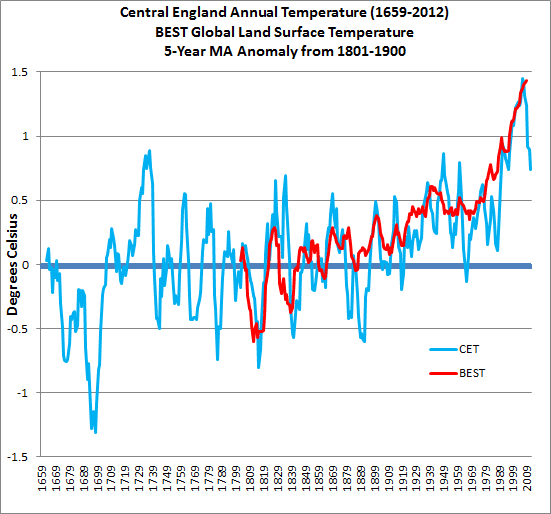
Climate science deniers like the Central England Temperature (CET) data series.  For example, Monckton uses it quite a lot as a 'proxy' for global temperatures. While Tony Brown (climatereason) writes on WUWT: 
As you also know CET is a good match to BEST ‘global’
Here is a chart showing the BEST global land surface temperature (from KNMI Climate Explorer) and Central England Temperature (HadCET) together, using a five year moving average of the 19th century (before global warming kicked in). (Click image to enlarge.)


Looking at the chart you can see that the local temperature anomaly for central England fluctuates a whole lot more than the global land surface temperature anomaly.  Most people would expect this to be the case, which is why it's surprising that Tony Brown, in his recent article on WUWT, writes (my bold and italics):
...the point I want to put over is that temperature is highly variable throughout the CET record -which is at variance to Dr Mann’s (global) work and the assertions of the Met office.
Naturally it is at variance with the global average temperature.  That is to be expected.  Tony goes on to say:
This is despite a constant level of co2 until around 1900. The temperature decline since 2000 as the CO2 line rises ever further is especially intriguing.
Does Tony think that before 1900 CO2 was the major forcing on global temperature? It wasn't.  As he points out, for the Holocene until at least the mid 1800s, atmospheric CO2 level varied very little.

And why does Tony find it intriguing that in a particular location on earth, temperature dropped for a couple of years.  Let's look at an animation of the modern record for CET just from 1950, with the 1961-1990 anomaly and different moving averages. (Click image to enlarge.)


I've chosen a five year average, an 11 year average and Dr Ben Santer's 17 year average (he says 'at least'). (Well, I took a liberty there - Dr Santer wasn't referring to moving averages.) Does your perception of the trend change looking over different time scales?

Now look behind the moving average trend line at the annual temperature anomalies.  Since 1986 or so, the CET temperatures have generally been considerably higher than those of the previous two decades, with colder than average temperatures in 1996 and 2010.  You'll recall that globally, 2010 was the equal hottest year on record (with 2005).  This demonstrates that the temperature in one small location in the northern hemisphere can't be extrapolated to the whole world.

You want SCARY?  How about a longer perspective...

Finally, how about we step way back and look at global temperatures from a very long term perspective, with the help of Jos Hagelaars and My View on Climate Change.  Using data from Shakun et al, Marcott et al,  HadCRUT4 and adding the IPCC AR4 "middle of the road emissions" projection to 2100. (Click image to enlarge.)


If that looks "scary" then so it should.  Is it any wonder that some fear sensitive souls want you to focus only on two years' temperature in the middle of a small island in the Northern Atlantic?


CO2 has an impact for millenia


CO2 has an impact for millennia.  Changing CO2 has an immediate effect and a very long term effect.  What we have done and continue to do is going to shape the global climate for many centuries. This chart from RealClimate.org and Paleosens 2012 shows the feedbacks and sensitivity to doubling of CO2 over different time scales. (Click image to enlarge.)


Here is a chart from NOAA showing the radiative forcing of long-lived greenhouse gases, relative to 1750. (Click image to enlarge.)


More Denier Weirdness

Here are a few excerpts from the comments to Tony Brown's article, from people who seem to think by looking at a WUWT chart of central England temperatures they suddenly know a whole lot more about climate science than climate science specialists, who have spent a lifetime studying the subject, building on the life work of scientific researchers who have gone before them:

Jer0me is a straight up Dismissive and says:
May 8, 2013 at 4:15 pm  To my mind,almost all of the graphs I have seen can be easily explained by the simple hypothesis that CO2 has no discernible effect on temperature whatsoever. I think this one is no different.

Larry Ledwick (hotrod) plays the stock market with temperature and says:
May 8, 2013 at 4:29 pm  What it shows me is that there is essentially zero correlation between CO2 concentrations and temperatures. Temperature is all over the place when the CO2 concentration was essentially uniform for about 3 centuries and now that CO2 is rising rapidly temperatures spiked in the early phase of the increasing concentration then simply stopped rising as the concentration curve turns up. A stock analyst would look at those two plots and toss out the CO2 concentration as being meaningless for predicting the temperature.

Talk about intriguing, Philip Bradley says:
May 8, 2013 at 5:12 pm  ...Humans have been influencing CO2 levels for millenia. Cutting down forests, killing the herd grazers,  I find the CO2 levels rising from the start of the Industrial Revolution especially questionable. Coal replaced charcoal as the industrial fuel, and producing charcoal with pre-industrial technology requires a fire that burns for about 3 days (I’ve seen it done). Producing large amounts of CO2, black carbon and organic carbon. Whereas, mining coal produces little CO2.

And deniers say climate scientists suffer from hubris!

Sunday, April 28, 2013

Hansen on CBC - plus WUWT HotWhopper of the Day: Wood is a Fossil Fuel

Sou | 1:23 PM Go to the first of 3 comments. Add a comment

WUWT-ers are up in arms about Dr James Hansen appearing on CBC and reasserting that: if nothing is done to stop Canada's oilsands development it will be "game over for the climate,".   They were particularly incensed by Hansen saying about the Canadian Government: "Well, the current government is a Neanderthal government on this issue...".

Speaking of the advances of Neanderthals, this WUWT comment caught my eye.  Did you know that wood is a fossil fuel and that burning it is what 'created fire'?:

Kenty Blaker says:April 27, 2013 at 6:30 pm  While the global warmists complain about the burning of fossil fuels they never coment (sic) on the fact that it was the burning of wood (a fossil fuel )that created fire. Without fire where would we be?
You learn something new every day!

Here's the interview with James Hansen from CBC News: