Some of you might remember how various WUWT-ers were hailing the temperature in Central England (HadCET) as heralding in an ice age. Two years ago a denier at WUWT was claiming that an ice age cometh, and pointed to HadCET - which, as you'll see below, indicated no such thing. In June that year, David "funny sunny" Archibald made one of his famous failed predictions, that Central England was in for a cold spell. A few months later, a chap called Tony Brown claimed that HadCET showed temperatures were back to those of the 1730s, which was utter nonsense. (That is, they weren't!)
Now that particular temperature record has fallen out of favour. Not even the most ardent denier can deny it's got a lot hotter there in the past few years. I say they can't deny it, but they do, still.
Showing posts with label Central England. Show all posts
Showing posts with label Central England. Show all posts
Saturday, May 2, 2015

Sunday, October 6, 2013
Tony Brown's Cooling England
Sou | 4:45 PM Go to the first of 12 comments. Add a commentclimatereason says (excerpt, my bold italics):
October 5, 2013 at 11:40 am
...here is CET to 1772. Temperatures have been dropping sharply for a decade. We are back to the climate of the 1730′s.
http://www.metoffice.gov.uk/hadobs/hadcet/
tonyb
Here's the chart to which Tony linked:
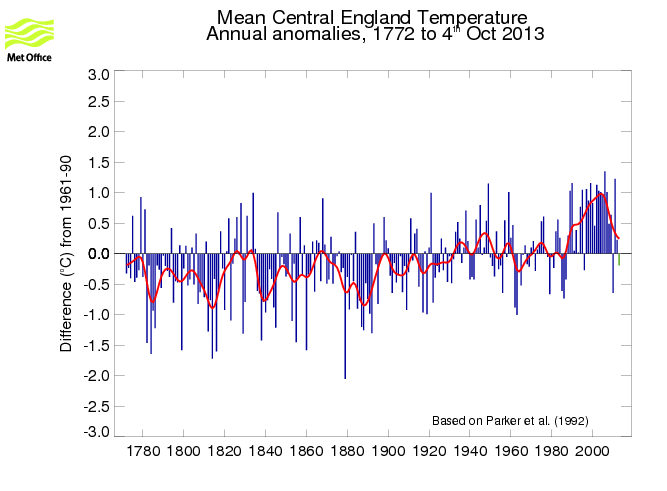
No, Tony Brown, Central England is not back to the climate of the 1730s
Tony has a case of confirmation bias. He claims that "we are back to the climate of the 1730s". To see if he's correct, we'll have to go to the longer record than the one to which he linked, which doesn't go back that far. Let's first look at the long term decadal record for HadCET, which is better than annual temperature anomalies when considering climate change. The trend becomes obvious:
 |
| Data Source: HadCET |
The 1730s decade is the teeny orange bit wedged between all the blue columns at the left of the chart above. Now to look in closer, here are the temperature anomalies from 2001 to 2012 and the temperature anomalies from 1731 to 1742 - the anomaly is from the twentieth century average:
| Year | Anomaly | Year | Anomaly | |
|---|---|---|---|---|
1731
|
0.35
|
2001
|
0.43
|
|
1732
|
0.19
|
2002
|
1.10
|
|
1733
|
0.97
|
2003
|
1.00
|
|
1734
|
0.30
|
2004
|
0.98
|
|
1735
|
0.04
|
2005
|
0.94
|
|
1736
|
0.80
|
2006
|
1.32
|
|
1737
|
0.42
|
2007
|
0.98
|
|
1738
|
0.31
|
2008
|
0.46
|
|
1739
|
-0.30
|
2009
|
0.61
|
|
1740
|
-2.66
|
2010
|
-0.67
|
|
1741
|
-0.20
|
2011
|
1.20
|
|
1742
|
-1.14
|
2012
|
0.20
|
|
Average
|
|
Average
|
0.71
|
Some years in the 1730s were quite warm compared to the century as a whole. But the climate back then was nothing like what it's been like lately, as indicated by surface temperature. Since 2001, the average temperature for central England was 0.71 degrees above the twentieth century average while the twelve year period since 1731 was 0.08 degrees below the twentieth century average. The two periods are hardly comparable.
Have temperatures been "dropping sharply"?
Tony Brown writes that "Temperatures have been dropping sharply for a decade." Let's see:
 |
| Data Source: HadCET |
The above chart shows that 2010 was a cold year in Central England. That year also happened to be the hottest year on record globally, equal to 2005. On the other hand, the following year, 2011, was the second hottest year ever in the 350 year record of central England temperatures, after 2006!
Here are the two periods compared in an animated chart, with the temperature scale held constant for easy comparison:
 |
| Data Source: HadCET |
The only similarity I can see is that both periods can be measured as anomalies from the twentieth century mean in degree Celsius!
Here is an animation of more periods for central England. Look particularly at the first part of last century, to 1969, compared to the time since 1970:
 |
| Data Source: HadCET |
Who is Tony Brown trying to kid? I don't know if he really thinks the world is about to enter another ice age or not, but if he does he's deluded.
 |
| Data Source: SkepticalScience.com |
In regard to what will happen in central England, that's another matter. At the macro level, here are the IPCC AR5 projections for temperature change under two emissions scenarios from the Summary for Policy Makers, page SPM-34 (click for larger version):
 |
| Source: IPCC AR5 WG1 page SPM-34 |
If the above is anything to go by, then England will get warmer if we keep burning fossil fuels. Maybe not as much as some areas but more than others. If we were to cut emissions and follow the RCP2.6 emissions pathway then temperatures in England might change very little from those of the period 1986-2005. However the opportunity to do that is fading fast.
Thursday, July 18, 2013
Ed "Ice Age" Hoskins is at it again on WUWT
Sou | 4:16 AM Go to the first of 3 comments. Add a commentEd Hoskins has written another article on WUWT. It's a very mixed up piece. He starts out arguing we're heading for an ice age, basing his assertion on very wrong premises. I've written about his nonsense before - such as here and here. These ice age alarmists are so tedious, aren't they. If Ed Hoskins put half as much effort into learning about science as he does protesting and denying it, he could almost pass for an educated man.
Ed says the earth is as cold as Central Greenland
Ed starts out with Don Easterbrook's favourite trick, equating the temperatures on the summit of the ice sheet in Greenland with those of the whole world. He even writes (I kid you not!):
The temperature record of the Holocene can be seen in the GRIP[3] Greenland ice core data.No, Ed. The temperature record of the Holocene on the Greenland ice sheet can be seen in the Greenland ice core data. That's not the whole world and nor do changes there reflect the changes in the whole world. Apart from it being darned cold up there, the temperatures in the Arctic are amplified and have much bigger fluctuations than the earth as a whole. (Ed doesn't bother to explain why the earth isn't a snowball and how we manage to exist or why his other favourite spot, Central England, isn't buried under two kilometres or more of ice. I suppose he thinks if it's good enough for an Emeritus Professor it's good enough for him.)
Ed's wrong: Central England is hotter than ever
Next, he claims that Central England temperatures have dropped therefore an ice age cometh. He writes:
However since the year 2000 a change has occurred: the CET record shows a marked reduction from its high levels loosing all the gains that it has made since 1850, even though at the same time CO2 levels have escalated further to ~400ppmv.
Let's just look at that. (Click to enlarge.)
 |
| Data Source: UK Met Office Hadley Centre |
Central England had a cold year when the world as a whole had the hottest year on record - in 2010. The following year, 2011, was among the hottest, but Ed stops his chart before that year. He stops at 2010 and doesn't include the last two years. And it was only four years earlier than his favourite coolish Central England but hottest year on record for the rest of the world, in 2006, that Central England had its hottest year on record. Just looking at the general trend, like the eleven year moving average, I think it's fair to say that Central England no longer has the climate of the mid-nineteenth century. And the temperatures in Central England also fluctuate a lot more than those of the earth as a whole.
So much for Central England cooling down. In any case, since when was Central England the whole world?
And speaking of England - the Met Office says it's warmer than usual right now! More here in the Telegraph. And in the USA and in India. (How's that ice age alarmism going, Ed?)
And speaking of England - the Met Office says it's warmer than usual right now! More here in the Telegraph. And in the USA and in India. (How's that ice age alarmism going, Ed?)
Ed's wrong again: We are not due for an ice age for at least 50,000 years
Then he goes for another myth. Ed claims that:
On past experience, our current benign interglacial period should or could be drawing to its close.What past experience he doesn't say. The only hint as to what is in his mind is his reference to the Eemian, which he claims lasted only 10,000 years. That's not so if Wikipedia is anything to go by. The Eemian "began about 130,000 years ago and ended about 114,000 years ago." By my arithmetic that means it lasted 16,000 years. A big difference when Ed's argument is based on the fact that the Holocene began about 10,000 years ago. Even if you only went by arithmetic rather than science, we'd have another five or six thousand years to go.
But that's not the whole story. In this paper in Science, Berger and Loutre calculate that even without global warming, Earth wouldn't start getting cold for at least another 50,000 years. That's because of the calculated insolation in future years. Here is a diagram from their paper:
 |
| Long-term variations of eccentricity (top), June insolation at 65°N (middle), and simulated Northern Hemisphere ice volume (increasing downward) (bottom) for 200,000 years before the present to 130,000 from now. Time is negative in the past and positive in the future. For the future, three CO2 scenarios were used: last glacial-interglacial values (solid line), a human-induced concentration of 750 ppmv (dashed line), and a constant concentration of 210 ppmv (dotted line). Simulation results from (13, 15); eccentricity and insolation from (19). |
Humans have added 43% more CO2 to the atmosphere
Ed tries to argue that humans have only added 3% to atmospheric CO2. How he comes up with that number defies all science, logic and arithmetic. What Ed writes is this:
In addition the Global Warming advocates assume that all increases to CO2 concentration are due solely to man-made additions. This is not necessarily the case, as the biosphere and slightly warmer oceans will outgas CO2 and the Man-made contribution is only a minor part of that CO2 transport within the biosphere, possibly as small as 3% of the total[26].No, Ed. The oceans are still absorbing CO2 not outgassing it. Partial pressure is outweighing the temperature effect by a long way still. In fact, if roughly half of our emissions weren't being swallowed up in the oceans, we'd have already almost doubled atmospheric CO2. As it is, (400-280)/280 = 43%.
CO2 and Energy
Then, as if he suddenly decides that CO2 emissions are important after all, Ed starts into some weird if well documented journey into carbon emissions by country, pessimistically saying it's all too hard. I say it's well documented but must point out that most of these "documents" are from highly suspect sources like denialist websites.
I'm not going to go into all Ed's arguments or 'evidence' on that score. What I do suggest is that if you do read what Ed writes, make sure you also read this new report from the International Energy Agency: World Energy Outlook Special Report 2013: Redrawing the Energy Climate Map.
As a taste, here are a couple of charts. The first is energy-related CO2 emissions by country:

This next one shows per capita emissions and GDP by selected countries from 1990 to 2012:

The IEA seems to think we can still manage to get through this if we put our collective minds to it. It writes of a New Policies Scenario and a 450 Scenario. I'm still working through the report so I won't try to say any more for risk of misrepresenting it.
Re-capping the main points
The main points here are:
- Assume anything and everything you read on WUWT is wrong or worse unless you can verify it in triplicate from reputable sources.
- Don't lose hope that the world can shift to clean energy and survive global warming, (albeit probably still with the mass extinction event sooner rather than later).
Subscribe to:
Posts (Atom)
