.
Showing posts with label arctic. Show all posts

Sunday, January 7, 2018

The latest conspiracy theory from WUWT science deniers - losing their grip on ice

Sou | 2:52 AM Go to the first of 3 comments. Add a comment
The latest conspiracy theory from science deniers at WUWT is that the National Snow and Ice Data Center (NSIDC) is up to something nefarious. (Seeing nefarious intent in the most innocuous actions is one of the hallmarks of conspiratorial thinking.)

All the fuss was about a new version of NSIDC's Sea Ice Index. It's gone from version 2 to version 3. In the latest version, monthly averages are calculated in a different way. The new version only affects monthly averages, not anything else. From the analysis report:
The Sea Ice Index has been updated to Version 3 (V3). The key update in V3 is a change in the method for calculating the numerical monthly averages of sea ice extent and sea ice area data values; that is, the data distributed in .csv and .xlsx format. This change impacts only the monthly data values in the Sea Ice Index time series and not monthly sea ice extent and concentration maps that accompany the data product, that is, the .png, .tif, and shapefile archives. Daily data are also not impacted, nor are any current conclusions drawn from the Sea Ice Index data set about the state of sea ice in either the Arctic or the Antarctic. This change is being made in response to questions raised by users of the product concerning how the monthly average ice extent and areas are calculated.

Thursday, February 9, 2017

Not the hottest January in the troposphere, but way hotter than normal in the Arctic

Sou | 11:52 PM Go to the first of 4 comments. Add a comment
The troposphere temperatures for January 2017 were released earlier this month. The lower troposphere is recorded in UAH v6 and RSS TLT v3.3. This report also covers RSS TTT for the troposphere (without the "lower") and follows pretty much the same format as previous monthly updates.

For RSS TTT (troposphere), the 12 months to January 2017 remain the hottest 12 months in the record (comparing similar Feb-Jan periods). January itself was the just the fifth hottest January, with January 2016 the hottest.

The lower troposphere (UAH v6) also showed the 12 months to January as the hottest on record. However, January was only the seventh hottest January on record, with January 2016 the hottest.

Tuesday, November 22, 2016

Weather weirdness in the Arctic - record high temperatures and record low sea ice

Sou | 8:55 AM Go to the first of 26 comments. Add a comment
The extraordinary situation in the Arctic has to be mentioned before too many more days have passed. I've no time to write a detailed article at the moment, so what I'll do instead is post some information that's been around the traps lately. First some tweets from Zach Labe (@ZLabe), who has been keeping us all informed on Twitter.

Thursday, August 25, 2016

Time to look at the Arctic sea ice 2016

Sou | 12:15 AM Go to the first of 15 comments. Add a comment
There has been some unusual weather in the Arctic again and it's even captured the attention of deniers. Arctic ice watcher, Neven, has been keeping a close eye on arctic cyclones and their impact, aided by other people who have built up some knowledge in the subject. They are wondering if these sort of events will happen more often than they used to. Earlier this year, in early spring, Arctic sea ice was at record low levels for that time of the year. It's not kept this place however it is still very low, being currently the third lowest on record for the time of year, just above 2007.

Anthony Watts is a blogging climate conspiracy theorist who tries to downplay climate change. He has built up a reputation in the dim corners of the internet for promoting "climate hoax" conspiracy theories and "ice age cometh" articles. Yes, even this year, during the hottest decade on record, and what will probably be the third in a row hottest year on record, and after ten "hottest months" on record, and the hottest ever month on record. As the world heats up relentlessly, deniers are looking crazier and crazier.

Friday, June 10, 2016

Greenland 2015: Anthony Watts denies Arctic amplification

Sou | 3:04 AM Go to the first of 17 comments. Add a comment
Arctic amplification means that surface temperatures in the high northern latitudes are rising faster than elsewhere. The reasons for this include positive feedbacks from the reduced ice cover as the world heats up.

Anthony Watts has announced that he's an Arctic amplification denier (archived here). He doesn't "believe" this is happening:
Figure 1 | Temperatures anomaly for the period 2001-2015 by latitude. The base period is 1951-1980. The chart clearly shows the Arctic amplification to the right. Data source: GISS NASA

Actually, I don't think Anthony knows what Arctic amplification is. In his blog article at WUWT today, he was writing about a new paper on the Greenland melt of 2015, saying:
And in this case, they are citing a single event to claim “Arctic amplification” has set in. 
There are all sorts of things wrong with that sentence.

Friday, April 8, 2016

Most of the Arctic sea ice is on land and other WUWT musings

Sou | 3:51 AM Go to the first of 10 comments. Add a comment
Arctic sea ice from 1953
 Willis Eschenbach has been wondering about sea ice trends of the past few decades. He's written a couple of articles but seems to me to be more interested in hiding the trends than exploring them. In today's article (archived here, latest here), he has used HadISST data from the UK Met Office Hadley Centre. I don't know why he chose that over the more often cited Sea Ice Index from the National Snow and Ice Data Center.  I think he's meant his title to this latest article to be sarcastic, in the way that the Dunning-Kruger set use sarcasm: "The Awful Terrible Horrible Global Sea Ice Crisis".

Willis decided to look at the data from 1974 only because he found that for Antarctica before that time there was not good data. Then he said he removed the seasonal component, which looks like he deducted something from each month. Since Willis used HadISST data, let's look at what the authors of the authoritative text on the subject found in the 2003 paper by Rayner et al:

Friday, August 28, 2015

Arctic sea ice extent is fourth lowest so far this year

Sou | 10:34 PM Go to the first of 23 comments. Add a comment
It's that time of the year again when the sea ice in the Arctic is disappearing. It doesn't look as if there will be a record low extent this year, but there's not a lot of ice around. At the moment it's the fourth lowest on record for this time of the year, according to the interactive chart provided by NSIDC (with my annotations).

Source: National Snow and Ice Data Center (NSIDC)

There are links to most of the main sea ice pages on the HotWhopper Climate Metrics page. Here are a couple of charts from the University of Bremen, as at 28 August 2015:


To stay up to date with what's happening, go to Neven's Arctic Sea Ice Blog.  His latest article is about a storm in the Beaufort Sea, which is undoubtedly breaking up ice in that region.

There's not much more to say, except to express concern that the region is at high risk. Not just from melting sea ice and all the changes that brings, but from shipping traffic and resource exploration. Those risks affect the Arctic and because of the wider impact of changes in the Arctic, affect the whole world.

I'll keep an eye on things and probably post an article shortly after the minimum, which should be within the next three weeks.

Sunday, July 12, 2015

Reflections from surface and clouds - is there an albedo expert in the house?

Sou | 4:36 PM Go to the first of 10 comments. Add a comment
Wondering Willis Eschenbach is a mite upset (archived here, latest here) because scientists aren't telling him he's right. In fact, they aren't telling him anything at all. And few of the readers at WUWT are helping him out, though a number are encouraging him with "scientists don't know nuffin'" comments.

Warnings - This article is long and meanders a bit - I have to call a halt at some point. This is just a blog article after all :) If you are looking for definitive answers about albedo, you won't find them. What you will get are some of the interesting bits and pieces I discovered as I went looking. There's no guarantee I've got it all right, either. This is something I've not explored in depth before now. So feel free to quibble in the comments.

Back to Willis Eschenbach. He thinks he's found a problem with a chart in a paper by Graeme Stephens of NASA's Jet Propulsion Laboratory in Pasadena (and elsewhere), and colleagues. The paper is about planetary albedo, which is the the fraction of the incoming solar energy scattered by Earth back to space. It's not a bad introduction to the subject, with some caveats as you'll see. The authors make two main points, as described in the abstract:
  1. the Northern and Southern Hemispheres (NH, SH) reflect the same amount of sunlight within ~ 0.2Wm 2. This symmetry is achieved by increased reflection from SH clouds offsetting precisely the greater reflection from the NH land masses. 
  2. The albedo of Earth appears to be highly buffered on hemispheric and global scales as highlighted by both the hemispheric symmetry and a remarkably small interannual variability of reflected solar flux (~0.2% of the annual mean flux).

Thursday, May 28, 2015

Anthony Watts and his ozone hole deniers are out in force (again)

Sou | 2:29 AM Go to the first of 16 comments. Add a comment
In yet another "claim" headline, Anthony Watts shows yet again how he denies science. Not just climate science but atmospheric chemistry as well. This, mind you, is the same week as he sent his fans to spam Wikipedia denying his denial of science.

This time his headline is about a press release that he copied and pasted, about the ozone layer (archived here). Anthony's denial only comes via his headline: Claim: ‘Severe ozone depletion avoided'. It's not the first time he's denied that ozone-depleting substances such as chlorofluorocarbons (CFCs) react with ozone in the stratosphere, destroying it (see further reading below).

The paper, by Professor Martyn Chipperfield and colleagues, is in Nature Communications. The authors discuss how the ozone hole would have been much worse had the world not agreed (through the Montreal Protocol) to stop releasing ozone-depleting substances. The researchers developed a model to investigate what would have happened if action had not been taken. They describe this as (from the abstract, my dot points and emphasis):
  • A deep Arctic ozone hole, with column values <120 DU, would have occurred given meteorological conditions in 2011.
  • The Antarctic ozone hole would have grown in size by 40% by 2013, with enhanced loss at subpolar latitudes.
  • The decline over northern hemisphere middle latitudes would have continued, more than doubling to ~15% by 2013.

Thursday, January 15, 2015

Despite the winter ice, Rolf E Westgard's pants catch fire at WUWT

Sou | 1:49 AM Go to the first of 20 comments. Add a comment

Why can't deniers just deny science? Some of them have to go further and make up stuff.

Today there's an article by someone called Rolf E. Westgard who's a petrol head as far as I can tell.  He's been featured here before, waffling on about clouds.

This time he's decided to see how many fibs he can tell in a single "guest essay". As with all good fibs, he skirts around the facts - quite a long way around. He mostly manages to avoid bumping into them.


Friday, December 19, 2014

Wondering Willis Eschenbach looks for sunlight in the Arctic winter - yeah, really!

Sou | 2:00 AM Go to the first of 80 comments. Add a comment

Anthony Watts posted a press release from AGU14. That's all the "scientific" reporting he's capable of I'd say. The articles he's written himself are science-free, but he has managed a couple of press releases (he didn't have to go to any AGU meeting to copy and paste a press release).

Anyway, one of the press releases was from NASA, which you can read in full here. Or if you prefer, you can read it on the archive of Anthony's blog here. Here's an extract (my emphasis):
NASA satellite instruments have observed a marked increase in solar radiation absorbed in the Arctic since the year 2000 – a trend that aligns with the steady decrease in Arctic sea ice during the same period.

Sunday, August 24, 2014

Denier Smorgasbord: Old men want freedom to vacuum madly, the Arctic and Judith Curry's "interesting"

Sou | 8:26 PM Go to the first of 41 comments. Add a comment

There are two reasons why you've not seen the usual number of articles here the last few days. The first is I've been busy on other things, unrelated to climate science and its denial. The second is that deniers have been deadly dull. They've been recycling the same old tired and wrong denier memes for the most part. Nevertheless, there's always some entertainment to be had at denier blogs, even when the pickings are thin.

Making criminals of "average" people who clean their home?


The ageing conservative American men who dominate WUWT have been bemoaning the latest news about their favourite task, vacuum cleaning. A subject I'm sure they are intimately familiar with. They probably see it done several times a week, from the comfort of their favourite rocker. If they aren't out playing golf. And I'll bet that most of them swear they could do the job better than the person who actually does the vacuuming. What they are up in arms about is the idea that were they to live in Europe, in a few weeks they wouldn't be able to buy their womenfolk vacuum cleaners that suck up any more than 1600 watts of electricity (archived here). Anthony Watts even goes so far as to claim that:
"One more reason to dump the EU- they are going to make criminals out of average people who just want to keep their home clean. – Anthony". 
He probably meant "who just want their women to clean up after them". And of course, he's wrong. People can continue to use their old vacuum cleaners. Even men can do so. Even conservative ageing men who deny climate science can do the vacuuming any time. It's just that in future, if they want to buy a new vacuum cleaner, their purchasing choice will be restricted to more energy efficient units.


The Arctic is melting and it's driving deniers mad


Anthony Watts posted an extremely long (>13,000 words) and what seems to me a convoluted article by Tony Brown, of central England temperature / an ice age cometh fame. It was more of a novella than a "guest essay". (Archived here.) I might come back to that one later on. I did notice a comment by Steve Mosher at Curry's place, which related to Tony's article. Steven Mosher wrote:
August 23, 2014 at 10:14 pm
tony “However, the conclusion must be that drawn that warming was more widespread in the arctic generally -not just the Atlantic side-than is currently noted in the official sea ice data bases covering1920-1945/50 and that the official records appear to substantially overstate the ice area extent. Some of the thinning of the ice and reduction of glaciers noted today appears to have had their genesis in the period referenced, or earlier.”
with no actual numbers, no actual method, no actual uncertainty calculations, I fail to see how your conclusion MUST BE drawn.
In general we have a collection of text that is long on adjectives and short on quantitative analysis. Further since we have apples and oranges to compare its hard to say anything MUST be drawn.
Finally, I find it odd that today when it warms and the arctic melts, skeptics, such as Anthony point to the wind and soot .. as if warmer temps did nothing. but when looking at historical records they quickly assume that warmer temps mean less ice. I dont doubt the latter, I only note the inconsistent application of a principle amongst skeptics

Judith Curry finds John McLean "interesting"


Judith continues to wallow in the depths of denialism, finding an article by Australia's John McLean "interesting". John's the computer operater / climate science denier who somehow managed to get a paper published, in which he removed the temperature trend from global surface temperatures and then looked at what remained and declared there was no trend. To much hilarity from all whose knowledge of statistics was at least sufficient for them to calculate an average of two numbers. John also declared, in 2011, that  "It is likely that 2011 will be the coolest year since 1956". Guess how that turned out! John is a denier of the utter nutter kind and so is Judith Curry, for giving him the slightest bit of credibility.


From the WUWT comments


This is a bit of a mish mash from a couple of WUWT articles. First from the vacuum-cleaning experts:

Andrew N has done his sums. I wonder how many times he's pulled out a vacuum cleaner? He says:
August 22, 2014 at 9:18 pm
It appears the ecocrats of the EU have confused power with energy. If it takes you twice as long to clean while using half the power then you have used the same amount of energy. Have they factored in the CO2 generated by the increased effort required by the vacuumer in any of their saving the planet calculations?

Eric Worrall decides that using an energy efficient vacuum cleaner is the worst punishment that could be doled out to anyone, causing much pain and misery all around. He visits from time to time. Perhaps he'll share some tips from his years of experience with vacuuming cleaning his floors. He says:
August 22, 2014 at 9:46 pm
In a totalitarian state, the measure of your power is how much misery you can cause.
Anyone can be nice – but spreading pain and misery proves to your colleagues that you are powerful. 

There were 58 comments to Tony Brown's book. Here is a sample:

Nick Stokes says, of Tony Brown's article:
August 22, 2014 at 5:52 pm
Congratulations, Tony
A very informative post
I don't know which bits Nick found informative.

Paul Homewood says (extract):
August 22, 2014 at 2:43 pm
It’s a bit long!!

FergalR says:
August 22, 2014 at 2:54 pm
I can’t possibly read all this while drunk. Maybe tomorrow afternoon. More likely Monday evening.
Hans H says:
August 22, 2014 at 3:32 pm
Dunno why u spread this Noaa/Giss stuff ? Check raw data n do it again. ” as seen in the graph” is not ok..n really Wuwt must know by now ?


Sorry for the paucity of articles the last few days. I'll hope to do better this coming week.  BTW, feel free to point out how sexist I was, poking fun at all the old conservative men getting upset about vacuum cleaners. I think I was being ageist rather than sexist. And there's good grounds for the stereotyping, don't you think?


Foster, G., J. D. Annan, P. D. Jones, M. E. Mann, B. Mullan, J. Renwick, J. Salinger, G. A. Schmidt, and K. E. Trenberth. "Comment on “Influence of the Southern Oscillation on tropospheric temperature” by JD McLean, CR de Freitas, and RM Carter." Journal of Geophysical Research: Atmospheres (1984–2012) 115, no. D9 (2010).  doi:10.1029/2009JD012960
.

Friday, August 1, 2014

Next surfing hotspot - the Arctic Ocean, plus record drought in California

Sou | 4:02 PM Go to the first of 16 comments. Add a comment

A couple of items to whet your appetite for the end of week fare.

Big waves in the Arctic


Off to surf the Arctic
There have been record high waves in the Arctic, which will probably make the ice disappear more quickly in coming years. Back in September 2012, scientists measured waves of five metres or 16 feet. Maybe that's not quite enough to attract surfers from Bell's Beach, yet it's a lot more wave action than there used to be.


With the ice retreating further and further from the shores, the waves are able to grow bigger and bigger. It's suggested that these bigger waves will churn up ice and hasten its demise. Less ice means more waves - a feedback loop. While bigger waves might be great news for surfers, it will make it harder for shipping and will also exacerbate shoreline erosion. From ScienceDaily.com:
Arctic ice used to retreat less than 100 miles from the shore. In 2012, it retreated more than 1,000 miles. Wind blowing across an expanse of water for a long time creates whitecaps, then small waves, which then slowly consolidate into big swells that carry huge amounts of energy in a single punch.
The size of the waves increases with the fetch, or travel distance over open water. So more open water means bigger waves. As waves grow bigger they also catch more wind, driving them faster and with more energy.
Shipping and oil companies have been eyeing the opportunity of an ice-free season in the Arctic Ocean. The emergence of big waves in the Arctic could be bad news for operating in newly ice-free Northern waters.
"Almost all of the casualties and losses at sea are because of stormy conditions, and breaking waves are often the culprit," Thomson said.
It also could be a new feedback loop leading to more open water as bigger waves break up the remaining summer ice floes.
"The melting has been going on for decades. What we're talking about with the waves is potentially a new process, a mechanical process, in which the waves can push and pull and crash to break up the ice," Thomson said.
Waves breaking on the shore could also affect the coastlines, where melting permafrost is already making shores more vulnerable to erosion.
The observations were made as part of a bigger project by a sensor anchored to the seafloor and sitting 50 meters (more than 150 feet) below the surface in the middle of the Beaufort Sea, about 350 miles off Alaska's north slope and at the middle of the ice-free summer water. It measured wave height from mid-August until late October 2012.

Jim Thomson and Erick Rogers have written a paper about this (open access). You can read it here, or read about it at ScienceDaily.com.


Extreme drought in California


The other bit of news this week was that while drought conditions are improving in some parts of the USA, they are getting much worse in California. 58.4% of California is now in extreme drought.

Source: The National Drought Mitigation Centre


Funnily enough Anthony Watts, who hails from California, hasn't written about it on his blog. In fact for all his moaning about manners, he is scorning the suffering that the drought is bringing to farmers and others in his home state. He tweeted "and that's nothing that the state has not experienced before".

By some measures the state may not have experienced a drought like this one before, at least not as part of the USA. The megadroughts happened well before there ever was a US state of California. It only formally became part of the United States in 1850.

Back in Australia, Queensland isn't faring too well at the moment, either. This is the latest map I could find, from May this year:

Source: The Long Paddock, Qld Government


Meanwhile south of the Queensland border, fires have been busting out early in NSW.


Jim Thomson, W. Erick Rogers. "Swell and sea in the emerging Arctic Ocean". Geophysical Research Letters, 2014; 41 (9): 3136 DOI: 10.1002/2014GL059983

Thursday, July 3, 2014

About increasing winter Antarctic sea ice and decreasing summer Arctic sea ice

Sou | 5:35 AM Go to the first of 8 comments. Add a comment

Science deniers are making a lot out of the growth in Antarctic sea ice, mostly over winter.  Strangely enough they aren't accusing scientists of fabricating the data, for a change.

Here's a chart from The Cryosphere Today (not, as Anthony's ill-informed "guest" referred to it, Today Cryosphere or maybe just Cryosphere). It's hit a record high for this time of year - ie since 1979.

Source: The Cryosphere Today

The main reasons for the increase in sea ice are described very nicely in this thread on the Arctic Sea Ice Forum (h/t Neven). As AbruptSLR points out:
...on average the Antarctic Sea Ice Area is going up by 0.2% per year, and the average thickness is going up 0.2% per year, resulting in an average sea ice volume increase of 0.4% per year.  However, these numbers are orders of magnitude lower than the corresponding changes taking place to the Arctic Sea Ice.

I did this chart last year (you can read my previous article on the subject here, with some reading material about models not projecting the observed increase in Antarctic sea ice). I combined the Arctic and Antarctic at their respective minima to illustrate the point. That means I've put the September values in the Arctic with the February values for Antarctica. It's missing the latest years. I'll update it after September if I remember to do so. Click to see it larger, as always.

Data source: NSIDC

The big impact on climate is in the summer. It's summer ice cover that affects albedo, not mid-winter ice, when the poles are in darkness. (Not that there's any sea ice at the South Pole.)

As for why the sea ice in the southern oceans is increasing, AbruptSLR has this to say (and a lot more besides):
Denialist should be aware that not only is the average water temperature in the Southern Ocean increasing with time, but also the air temperature above the Southern Ocean is increasing with time, and the following linked research makes it clear that the most significant reason why the Antarctic Sea Ice is increasing is due to the formation of the seasonal Antarctic ozone hole after the mid-1980's created by anthropologically induced chlorides in the upper atmosphere over Antarctica; which in turn caused the circumpolar Antarctic westerly wind velocity to increase (see the following abstract for the influence of this increased wind velocity on the Antarctic Sea Ice); and the linked reference indicates that the intensifying regional winds in Antarctic is one of the most significant factors accounting for the increasing maximum extent of Antarctic sea ice. 

There is a lot of useful information and references to scientific papers in that thread. I don't have time to research and write about this right now. And I doubt I could do it any better than AbruptSLR in any case, and probably a lot worse.

Again, here is a link to the discussion. It's well worth a read, especially for anyone who wants to rebut denialist nonsense on the subject.

As for what's happening in the Arctic, well somewhat surprisingly, the ice extent is dropping quite a bit. It doesn't look as if it will break the 2012 record low though. Neven's blog is the place to go to keep up with what's happening there.

Source: Arctic Sea Ice Monitor

From the WUWT comments


Anthony Watts prefers to focus his readers attention on Antarctica, rather than the Arctic and to spread his usual disinformation about. Here are some of the mindless comments he hoped for and got:

Lucius von Steinkaninchen says:
July 2, 2014 at 11:24 am
* * * It’s getting colder around Antarctica and so the ice is growing * * *
In a world of some fields of Science degenerated enough to forget Occam’s Razor, it is so refreshing to see a simple model tying up cause and effect…

Bob Diaz says:
July 2, 2014 at 11:25 am
It appears that reality does not agree with the computer models.
How could reality be so wrong??? ;-))

Ben Howison says:
July 2, 2014 at 11:27 am
Looks kinda like a hockey stick, doesn’t it? 

Shawn from High River is about the only person who says something sensible, but I doubt he realises it. He says:
July 2, 2014 at 11:29 am
When these pesky facts get in the way of the prevailing theory,they just modify the theory to suit the facts

JimS says:
July 2, 2014 at 11:41 am
It is all so logical, it is astounding that no one can catch onto a very simple principle.
At the north pole, when sea ice trends to diminish, that means it is a sign of global warming.
However, at the south pole, on the opposite side of the earth, sea ice is increasing. But since this is on the opposite end of the earth, increasing sea ice means that is a sign of global warming.
These are opposite poles you see, so the exact opposite trend means the same thing. It is all global warming! 
Sheesh! (/sarc) 

John Schwartz says:
July 2, 2014 at 11:51 am
Just doesn’t fit the narrative, does it…  

Saturday, June 21, 2014

Jim Steele, greenhouse effect denier, gets up to his tricks in the Arctic

Sou | 12:02 AM Go to the first of 6 comments. Add a comment

Anthony Watts is on a roll wheeling out one greenhouse effect denier after another. Yesterday it was Dr Lu who reckons that CO2 isn't working anymore. Now it's Jim Steele (archived here).

This article is quite long. It's not a bad example of denialism in action - from the WUWT article itself through to the idiotic comments that followed it. As well as relying on the very same scientific papers (and scientists) he scoffs at, Jim misrepresents them. Jim uses cherry picking mixed with disinformation. If Anthony Watts really wanted to be taken seriously, he wouldn't be promoting greenhouse effect deniers like Jim Steele. But Anthony doesn't want to be taken seriously, except as a true blue disinformer and fake sceptic. His first priority is to impress all his science-rejecting fans who willingly send him their hard-earned cash, and patrons like the Heartland Institute.

Jim Steele fails Logic 101


I don't know if Jim is lacking in the intellect department or if he's just pretending to be dumb, but he doesn't start off his article too well. He begins by attacking an article at SkepticalScience.com, without linking to it of course. He wrote:
At the website deceptively named SkepticalScience, they list “Climate Changed Before” as the skeptics’ #1 “mythical” argument. But the website’s authors have fabricated a straw man argument writing, “The ‘climate changed naturally in the past’ argument is a logical fallacy known as non sequitur, in which the conclusion doesn’t follow from the arguments.  It’s equivalent to seeing a dead body with a knife sticking out the back, then arguing the death must be natural because people died naturally in the past. It fails to even consider the available evidence.” 
Jim doesn't say what he finds to be the strawman in that passage that he quotes. I can't see one. Perhaps a reader can explain it. All I see is an explanation of why the notion that climates having changed in the past from other causes is no reason to reject the notion that it's human activities that are causing the current climate change. Pretty straightforward, I'd have thought.

Jim goes on and writes:
Then after wading through theoretical gish-gallop, the Skeptical Science author concludes their argument with a non-sequitur of their own-“Past climate change actually provides evidence that humans can affect climate now.”
Jim thinks the SkepticalScience article is a gish-gallop. Jim doesn't know what a gish gallop is. He is also mixing up two articles. SkepticalScience.com has two responses to the denier illogic: "climate changed naturally in the past [therefore it must be changing naturally in the present]". There is a short basic version and a longer intermediate version. Jim has taken the last sentence of the intermediate version out of context and wrongly labelled it a non-sequitur. (Jim isn't an expert in climate and evidence shows that neither is he competent at logic.) The statement is factual, accurate and stands on its own in any case. Past climate change does indeed provide evidence that humans can affect climate now.

Click "read more" if you want to read lots more nonsense from Jim Steele.

Wednesday, June 11, 2014

WUWT predicts highest Arctic September sea ice extent in ten years

Sou | 9:50 PM Go to the first of 15 comments. Add a comment

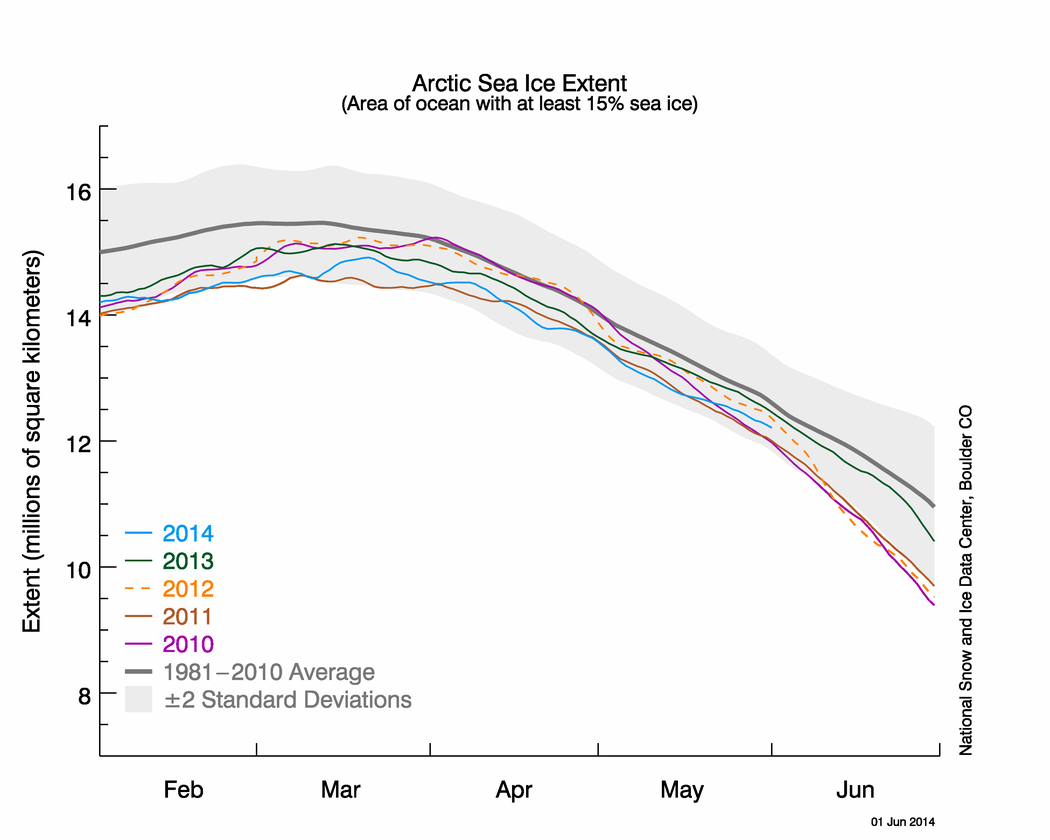
The readers at WUWT have put in their sea ice prediction to arcus.org at 6.11 million square kilometres average for the month of September. (Archived here.)

Here it is compared to previous September averages, I've put in a red line to show the WUWT prediction. Click to enlarge:

Adapted from arcus.org

Anthony applied a weighted average to the top five most popular predictions. WUWT-ers think the average ice extent will be the same as it was around ten years ago, in 2004.

Here are the averages for the month of September going back to 2006 (the archives didn't go back any further), from NSIDC:

  • 2006 5.9 million square kilometers
  • 2007 4.28 million square kilometers
  • 2008 4.67 million square kilometers
  • 2009 5.36 million square kilometers 
  • 2010 4.90 million square kilometers
  • 2011 4.61 million square kilometers
  • 2012 3.61 million square kilometers
  • 2013 5.35 million square kilometers
  • 2014? 6.11 million square kilometers? (WUWT prediction)

I myself won't take a guess. The Arctic is too fickle and I'm not an expert. Here's the latest chart from NSIDC. Click the image to view larger:
The graph above shows Arctic sea ice extent as of June 1, 2014, along with daily ice extent data for four previous years. 2014 is shown in blue, 2013 in green, 2012 in orange, 2011 in brown, and 2010 in purple. The 1981 to 2010 average is in dark gray. Sea Ice Index data.
Source: NSIDC

I came across a recent paper in Nature Climate Change by David Schröder, Daniel L. Feltham, Daniela Flocco & Michel Tsamados. The authors reckon they've come up with a better approach to predictions - look at the melt-pond area in the spring. The abstract says in part:
...here we show that the Arctic sea-ice minimum can be accurately forecasted from melt-pond area in spring. We find a strong correlation between the spring pond fraction and September sea-ice extent. This is explained by a positive feedback mechanism: more ponds reduce the albedo; a lower albedo causes more melting; more melting increases pond fraction. Our results help explain the acceleration of Arctic sea-ice decrease during the past decade. The inclusion of our new melt-pond model promises to improve the skill of future forecast and climate models in Arctic regions and beyond.

If you want to keep up with the latest in the Arctic, I recommend Neven's Arctic Sea Ice blog.


From the WUWT comments


william's contribution must be a Poe, he says he saw a NOAA documentary called "The Day After Tomorrow":
June 10, 2014 at 9:12 am
Whatever the extent, all of the Polar bears will be drowned and life on our planet will cease when the atlantic conveyor stops and North American temperatures drop to 100 degrees below zero. I saw a documentary put out by NOAA called “The Day After Tomorrow”. Thank goodness our president is going to shut down all the coal plants so that all those people dont freeze to death. There are not enough books to burn to stay warm through something like that!

Jim Hunt offers some good information about Arctic sea ice, but Anthony will have none of it. It's too sciency for Anthony who says that Arctic ice extent has nothing to do with volume:
June 10, 2014 at 9:32 am
Re: @Anthony says: June 10, 2014 at 8:55 am
It’s not my “own views” Anthony. In fact it’s a long list of useful facts and figures for anybody attempting to forecast the future of Arctic sea ice. A long list of useful information still noticeable only by its absence from the WUWT sea ice reference page.
REPLY: We aren’t forecasting volume, we are forecasting extent, so again, your views that we should pay attention to volume graphs on your website (your favorite hobby horse) in this extent forecasting exercise are irrelevant. Don’t clutter up this thread further – Anthony

Anthony really doesn't like scientific comments, it upsets his denier audience. He prefers comments like this one, from Joe Bastardi, award-winning meteorologist and greenhouse effect denier. Joseph Bastardi says (excerpt):
June 10, 2014 at 8:49 am
...One thing is certain. even if it gets NEAR NORMAL given what its been the past 10-15 years since the warm amo really took hold, we can safely say that co2 has nothing to do with this. ...

dbstealey is a Little Ice Age bouncer who keeps contradicting himself trying to cover too many bases while still denying human-caused global warming, and says:
June 10, 2014 at 9:38 am
As we see here, the planet is still recovering from the Little Ice Age. Naturally polar ice is going to decline.
Notice that in the [natural] global warming since the LIA, the trend has remained within its long term parameters. Despite all the alarmist predictions, there has been no acceleration in global warming [in fact, GW has stopped].
If polar ice declines, so what? As with rising CO2, that would be a net benefit: much shorter transit times for shipping, with much reduced fuel costs, an open northwest passage, less need for icebreakers, etc.
The only reason polar ice is discussed is because of the endless predictions that Arctic ice would soon disappear. The alarmist crowd is desperately hoping that it does. But so what if it does? It’s all good… and it’s all natural.

ripshin says it's cold in Virginia so there'll be a lot of ice in the Arctic in September:
June 10, 2014 at 10:18 am
June feels a lot cooler here in central Virginia than it used to…so I’m going with more ice: 7.75 MsqKM. “Today, I go for the gusto.”
rip

Steven Mosher linked to some charts (see third one down for different projections), but Anthony doesn't want to acknowledge the disappearance of Arctic sea ice:
June 10, 2014 at 11:20 am
https://sites.google.com/site/pettitclimategraphs/sea-ice-extent
REPLY:IMHO, any graph that uses “death spiral” as part of the description should be ignored – Anthony


Schröder, David, Daniel L. Feltham, Daniela Flocco, and Michel Tsamados. "September Arctic sea-ice minimum predicted by spring melt-pond fraction." Nature Climate Change (2014). doi:10.1038/nclimate2203

Friday, May 9, 2014

Arctic warming: It's not natural variability, it's all down to soot, sez Anthony Watts at WUWT

Sou | 3:14 PM Go to the first of 7 comments. Add a comment

In yet another "anything but CO2" article (archived here, latest update here), Anthony Watts wants to blame all the recent warming in Greenland on soot.  He reaches left, right, up and down to get out of carbon dioxide being a greenhouse gas and warming the world. Which is pretty funny when he also tries the "I'm a reasonable man, really I am" tack by posting articles where he pretends that he really does think there is such a thing as the greenhouse effect.

What's even funnier is that Anthony is downplaying the role of natural variability in his effort to blame soot for Greenland warming.


Changes in atmospheric circulation caused some of the Arctic warming


Anthony is disputing another Nature paper, this one is about attribution of the causes of the very high amount of warming in Greenland and north eastern Canada. Going by the abstract and the press release, the authors have concluded that up to half the recent warming in Greenland and north eastern Canada may be natural variability. These areas have been warming at around 1° Celsius a decade since 1979, which is about twice that of the global average temperature rise.  The scientists have found that about half of this (0.5° Celsius a decade) is related to changes in atmospheric circulation over the North Atlantic, caused by a warmer western tropical Pacific Ocean.

From ScienceDaily.com:
The natural variations in the new study related to an unusually warm western tropical Pacific, near Papua New Guinea. Since the mid-1990s the water surface there has been about 0.3 degrees hotter than normal. Computer models show this affects the regional air pressure, setting off a stationary wave in the atmosphere that arcs in a great circle from the tropical Pacific toward Greenland before turning back over the Atlantic.
"Along this wave train there are warm spots where the air has been pushed down, and cold spots where the air has been pulled up," Wallace said. "And Greenland is in one of the warm spots."
In previous studies, Wallace and Battisti have documented the existence of decades-long climate variations in the Pacific Ocean that resemble the well-known shorter-range El Niño variations.
This particular location in the tropical Pacific may be a "sweet spot" for generating global atmospheric waves. A series of studies led by co-author Eric Steig, a UW professor of Earth and space sciences, working with Ding and Battisti, showed that waves starting in the same place but radiating southward are warming West Antarctica and melting the Pine Island Glacier.
Researchers can't say for how long the tropical Pacific will remain in this state.
"Our work shows that about half of the warming signal in Greenland comes from the predictable part -- forcing of climate by anthropogenic greenhouse gases -- but about half comes from the unpredictable part," Steig said.

The atmosphere makes the world seem small


The world is large, but studies like this show that the world isn't so large that the ocean right down near New Guinea, which is in the tropical southern hemisphere can affect the Arctic, way up north. And at the same time this same area of the Pacific is causing atmospheric waves that are warming West Antarctica and melting the Pine Island Glacier.


Anthony's sooty fixation


Anthony doesn't believe it.  He wrote about a photo of a pool of water in Greenland, which I traced back to here originally.  Anthony isn't talking about the dirty snow in the foreground. He's talking about the dark section of the pool in the shadow.

Water Filled Canyon (Greenland) Although snow has dammed outflow from the lake, nearby melt streams continue to fill sections of the canyon where snow has not accumulated.

Anthony doesn't say how he can tell from a photograph what is causing the darker colour in the pool - whether it's dust or dirt or soot or algae or just extra deep water or all of these. Anthony Watts has done his photo-science and decided that it's definitely soot, writing:
[Note: part of the answer is in the photo they provide with the press release below, but they don't see it. - Anthony]...
...Note the black at the bottom of the melt pool, that’s carbon soot. That’s something the UW authors aren’t paying attention to....
…it has a big effect on albedo, and thus absorbed solar insolation, likely far more so than CO2 forcing, 

Another thing is, if Anthony had bothered to read the abstract and the references, he'd have noticed that the authors do indeed acknowledge that black soot does play a part in warming the Arctic (and the world). If he'd read the paper the scientists referenced, he'd have noticed that black carbon, although it does have a large effect it's not as large a forcing as CO2. As Hansen and Nazarenko wrote:
The substantial role inferred for soot in global climate does not alter the fact that greenhouse gases are the primary cause of global warming in the past century and are expected to be the largest climate forcing the rest of this century.

You may recall that Anthony has tried this argument before, misrepresenting the findings of another more recent study, which showed that the impact of soot on the Arctic depends on where it comes from. If it comes from the Arctic itself it will have a bigger impact than if it comes from the mid-latitudes. ("The Arctic surface temperature is almost 5 times more sensitive to black carbon emitted from within the Arctic than to emissions from mid-latitudes.")

Since I started this article, Anthony has added another photo showing how the albedo on Greenland has changed over the years. Thing is, it's not just dirt and dust and soot that causes the surface to become darker. As it states in the NASA article that Anthony refers to, it's not just soot:
Climate scientists have long expected that Earth’s icy North would become less reflective as global temperatures rose. Rising temperatures melt snow and ice. The uncovered terrain is darker—ocean water, vegetation, bare ground—so the area absorbs more sunlight than it used to, leading to more warming, which causes more melting. In short, the loss of reflectiveness amplifies the initial warming. This feedback is underway on Greenland’s ice, especially since 2006, a year that marks a fundamental shift toward a warmer, greener Arctic, according to the Arctic Report Card.
...The darkening in the non-melting areas, says Dr. Box, is due to changes in the shape and size of the ice crystals in the snowpack as its temperature rises. Snow grains clump together, and they reflect less light than the many-faceted, smaller crystals. Additional heat rounds the sharp edges of the crystals. Round particles absorb more sunlight than jagged ones do. 

Here is a chart showing overall contributions of humans to global warming. CO2 is by far the biggest followed by methane, but soot plays quite an important role as well. Click for larger view.

Figure TS.7 Radiative forcing of climate change during the industrial era shown by emitted components from 1750 to 2011. Source: IPCC AR5 WG1


A couple of other points. Anthony wants to blame the hotter Greenland and north eastern Canada on soot. What about the rest of the Arctic? Is soot not falling there? And is there more soot falling in the Arctic now than it did in the past?  I don't know the answer to those questions, but from what I've read there isn't any more soot being produced than there was in the past. If anything, it's decreasing.

The really weird thing is that in his focus on soot (much of which comes from human activity), Anthony is downplaying the role of natural variability in the recent rapid warming of Greenland and north eastern Canada, which is what the paper was all about after all.


From the WUWT comments


Surprisingly a lot of people are quizzing Anthony on his interpretation of the photograph he showed above. He's not having a good day.

Francisco Fernandez thinks that we should have all perished by now. He's quite impatient and has no concept of geological time scales when he says:
May 8, 2014 at 7:35 am
What I don’t get is, with all this modelling and VERY (sarc) high climate sensitivity, how is it that there’s still life on earth?
Wouldn’t the extintion of the dinosaurs, due to a catastrophic event that obliterated the species, would have caused more damage than mere CO2 <0.04%v/v?
Now, I am not sure if the dinosaur extintion due to the meteorite is a fact or theory. But if it is a fact, shouldn't it shed some light on how resilent the climate is?

steveta_uk thinks the study means he doesn't have to be concerned about global warming and says:
May 8, 2014 at 7:36 am
If they’re right, and 1/2 the warming is natural, then that about agrees with the recent lower estimates for sensitivity, and means that the expected 1.5C warming by 2100 is nothing to panic about.
So Steig has joined us at last!

john challenges Anthony and says:
May 8, 2014 at 7:40 am
Anthony, is it ALL carbon soot? Does wind blown glacial dust, or atmospheric dust, also take on a dark color when submerged? Not disagreeing about albedo effect, just wondering if carbon is the only source of dark coloration at the bottom of a melt pool on a glacier.

Billy Liar also challenges Anthony and says:
May 8, 2014 at 7:47 am
Can someone point to a chemical analysis of the black stuff in that Greenland pond?
I’m sceptical that it is ‘soot’. Oh, and where does the red stuff that you see over arctic glaciers occasionally come from?

When Paul Woland compliments Anthony for posting an article from Nature, Anthony sticks to his photo-science:
May 8, 2014 at 7:48 am
Well done WUWT for finally starting to publish research papers that, like virtually all climate-related papers in Nature, attests to the reality of significant temperature increases caused by carbon dioxide emissions.
REPLY: So like the authors of the paper, you missed what was in the photo too? – Anthony

SIGINT EX quibbles with Anthony, but Anthony is sticking to his guns:
May 8, 2014 at 8:15 am
No soot in the pool ! Just a photograph, low sun angle, shadow and diminished illumination against a very bright foreground on top ! Particulate measured in Firn and glacier ice is at the ppm level. Not enough to make a difference.
REPLY: No, sorry, you are wrong. It’s soot, dust, etc. people have sampled the bottom of those pools. Read the links provided before inserting foot in mouth. See map I’m adding from NASA showing deposition – Anthony

Neil says:
May 8, 2014 at 8:15 am
Stupid question: how do you know it’s soot and not some dark tunnel carved into the ice?

richard says:
May 8, 2014 at 8:27 am
To me the dark part looks like a deeper part of the water, i notice that there are no darker parts elsewhere or if it is does the movement of water carry it to one part.
The bottom of the picture shows discoloration of the snow- soot? that has melted and yet everywhere else looks pristine. 

Shawn in High River doesn't realise that the scientists have crunched the numbers and says:
May 8, 2014 at 8:44 am
How do they know that exactly half is due to AGW and the other half is the unpredictable part? How did they come up with that figure of 50% AGW ?

hunter confuses Greenland and north eastern Canada with the entire world when he says:
May 8, 2014 at 8:58 am
In a sense they are back peddling from the apocalypse. Now it is only 50% due to evil humans. Last year it was all human CO2. Is it due to highconfidence that the AGW believers have ‘won’ and will see their self-serviing policies imposed no matter the facts?

Steven Mosher becomes a bit impatient with Anthony Watts and his fake sceptics and says:
May 8, 2014 at 9:39 am
“Neil says: May 8, 2014 at 8:15 am Stupid question: how do you know it’s soot and not some dark tunnel carved into the ice?
1. There is no evidence that this photo shows soot.
2. Its assumed and asserted as fact.
3. Note the lack of skepticism about this “evidence”
That said, soot plays a role. thats part of the human forcing equation.
If you want to know how much of a role soot plays you have to run a GCM.
or you can just speculate and assert that it plays a major role.
Science: build a tool to try to understand the role of soot.
Politics: assert that its all down to soot. no comprehensive data, no methods, a few pictures, no testing of the hypothesis.. just assertion.

Doug Proctor also thinks that Greenland is the whole world and says:
May 8, 2014 at 9:55 am
To say that half is natural, not human-caused, is to say that you are a denier (of consensus, IPCC science). It is to say that any action to reduce human generated CO2 will have half the effect of the IPCC scenarios, and kill both the economics and the actual result of what is proposed “must” happen. 


Qinghua Ding, John M. Wallace, David S. Battisti, Eric J. Steig, Ailie J. E. Gallant, Hyung-Jin Kim, Lei Geng. Tropical forcing of the recent rapid Arctic warming in northeastern Canada and Greenland. Nature, 2014; 509 (7499): 209 DOI: 10.1038/nature13260

Hansen, James, and Larissa Nazarenko. "Soot climate forcing via snow and ice albedos." Proceedings of the National Academy of Sciences of the United States of America 101, no. 2 (2004): 423-428. doi: 10.1073/pnas.2237157100

Sand, M., T. K. Berntsen, Ø. Seland, and J. E. Kristjánsson (2013), Arctic surface temperature change to emissions of black carbon within Arctic or midlatitudes, J. Geophys. Res. Atmos., 118, doi:10.1002/jgrd.50613.

Thursday, January 30, 2014

How Expert is Arctic Climate Expert Judith Curry?

Sou | 11:52 PM Go to the first of 16 comments. Add a comment


Judith Curry has a blog post (archived here) in which she tries to justify this statement she made in her written testimony to a recent US Senate Committee Hearing.
Further, Arctic surface temperature anomalies in the 1930’s were as large as the recent temperature anomalies.

The Arctic and Antarctica


Judith made the statement in a section of her testimony about sea ice in the Arctic and Antarctica.  Judith included the following sentences in her written testimony, relating to Arctic sea ice and Antarctic sea ice.  Unlike other science I've read and despite the gross differences between the two regions, Judith packaged the Arctic and Antarctica together.  She wrote:
The increase in Antarctic sea ice is not understood and is not simulated correctly by climate models. Further, Arctic surface temperature anomalies in the 1930’s were as large as the recent temperature anomalies. Notwithstanding the simulations by climate models that reproduce the decline in Arctic sea ice, more convincing arguments regarding causes of sea ice variations requires understanding and ability to simulate sea ice variations in both hemispheres.

Her first sentence is more definite than the science I've read suggests.  If she'd written "is not completely understood" or even "not well understood" it would be a more accurate representation of the state of science.

Her second sentence is most likely incorrect, as we'll see below.  (I've emphasised that sentence in bold italics because it is going to be the main focus of this article.)  But while we're here, let me just ask the question - if the Arctic was as warm in the 1930s as it is now, how is it there was so much more ice in the Arctic region back then than there is today? On land and sea.

Her third sentence is out of the blue and as far as I can make out, doesn't link directly to anything else in her testimony (except it fits her general theme of "scientists don't know nuffin' so forget-about-it").

The differences between the Arctic and Antarctica are vast.  About the only similarity they share is they are both cold places with lots of ice. I'd be interested in what readers think about the "more convincing arguments" comment and just what Judith might mean by that.  Sure it applies to Antarctica, but I can't see that the Arctic and Antarctica are linked as closely as Judith seems to be suggesting.  I'm not arguing that what happens in Antarctica is divorced from the rest of the world or that it could not possibly have any impact on the Arctic.  Merely that what happens in Antarctica is unlikely to have any greater impact on the Arctic than it has on anywhere else in the world.  Similarly, what happens in the Arctic would not necessarily affect Antarctica any more than it would affect other regions in the world. And being in different hemispheres, they'd both arguably have less impact on each other rather than more.

So while it will be nice when all the different forces acting in the high latitudes of the southern hemisphere are better understood, I don't understand why Judith links Arctic sea ice with sea ice in the southern oceans.

However in this article I particularly want to discuss the recent blog article of Judith's in which she tries to justify her statement and respond to Tamino's criticism of Judith's writing:
Further, Arctic surface temperature anomalies in the 1930’s were as large as the recent temperature anomalies. 
(Tamino has also written a response, so I'll try to keep this short.)


Judith Curry is an expert on the climate of the Arctic


Now Judith introduced herself to the US Senate Committee as an expert on the climate of the Arctic.  The first two sentences of her written testimony show how she presented herself:
I am Chair of the School of Earth and Atmospheric Sciences at the Georgia Institute of Technology. I have devoted 30 years to conducting research on topics including climate of the Arctic, the role of clouds and aerosols in the climate system, and the climate dynamics of extreme weather events.

So the first area of expertise she listed was that of the climate of the Arctic.  So if anyone knows about the climate of the Arctic then she should.  I am aware Judith has had quite a few papers about the Arctic published, her most recent being as co-author of one of Marcia Wyatt's "stadium wave" papers I believe.

However, rather than cite any of her own work on the Arctic to support her statement that the Arctic was as hot in the 1930s as it is now, what Judith does in her blog article is select three passages from the IPCC AR5 report in the section on Arctic sea ice (plus some other material).  These are the sections she quotes - note they are not sequential in the IPCC report and are not adjacent to each other, though in her blog article Judith runs them all together as if they were a single segment.  All are from Chapter 10, "Detection and Attribution of Climate Change: from Global to Regional".

The first segment is from page 10-27 of AR5 WG1, in Section 10.3 Atmosphere and Surface:
Gillett et al. (2008b) detect anthropogenic influence on near-surface Arctic temperatures over land, with a consistent magnitude in simulations and observations. Wang et al. (2007) also find that observed Arctic warming is inconsistent with simulated internal variability. Both studies ascribe Arctic warmth in the 1930s and 1940s largely to internal variability. Shindell and Faluvegi (2009) infer a large contribution to both midcentury Arctic cooling and late century warming from aerosol forcing changes, with greenhouse gases the dominant driver of long-term warming, though they infer aerosol forcing changes from temperature changes using an inverse approach which may lead to some changes associated with internal variability being attributed to aerosol forcing. We therefore conclude that despite the uncertainties introduced by limited observational coverage, high internal variability, modelling uncertainties (Crook et al., 2011) and poorly understood local forcings, such as the effect of black carbon on snow, there is sufficiently strong evidence to conclude that it is likely that there has been an anthropogenic contribution to the very substantial warming in Arctic land surface temperatures over the past 50 years.

The above does not support or refute her contention that the Arctic was as warm in the 1930s as it is now. It's mainly blog padding.

The second segment is from page 10-43, except that Judith left out the first sentence of the paragraph, which I'll include as italics enclosed in square brackets.

[A question as recently as six years ago was whether the recent Arctic warming and sea ice loss was unique in the instrumental record and whether the observed trend would continue (Serreze et al., 2007).] Arctic temperature anomalies in the 1930s were apparently as large as those in the 1990s and 2000s. There is still considerable discussion of the ultimate causes of the warm temperature anomalies that occurred in the Arctic in the 1920s and 1930s (Ahlmann, 1948; Veryard, 1963; Hegerl et al., 2007a; Hegerl et al., 2007b). The early 20th century warm period, while reflected in the hemispheric average air temperature record (Brohan et al., 2006), did not appear consistently in the mid-latitudes nor on the Pacific side of the Arctic (Johannessen et al., 2004; Wood and Overland, 2010). Polyakov et al. (2003) argued that the Arctic air temperature records reflected a natural cycle of about 50–80 years. However, many authors (Bengtsson et al., 2004; Grant et al., 2009; Wood and Overland, 2010; Brönnimann et al., 2012) instead link the 1930s temperatures to internal  variability in the North Atlantic atmospheric and ocean circulation as a single episode that was sustained by ocean and sea ice processes in the Arctic and north Atlantic. The Arctic wide temperature increases in the last decade contrast with the episodic regional increases in the early 20th century, suggesting that it is unlikely that recent increases are due to the same primary climate process as the early 20th century.

Judith bolded the second sentence in the above passage and omitted the first.  A couple of people have made much of this, and I agree that it is ambiguous.  The second sentence could be read as a continuation of the first with the meaning: "As recently as six years ago it appeared as if Arctic anomalies in the 1930s were as high as those of the 1990s and 2000s".  Or it could be read as a standalone separate sentence, meaning that "today it appears as if Arctic anomalies in the 1930s were as high as those of the 1990s and 2000s".

If you choose the second interpretation then that second sentence is the only bit of Judith's IPCC quotes that supports her contention that the Arctic was as warm in the 1930s as it is today.  However it isn't consistent with anything else I've read in the IPCC report and I found no other statement of that nature in the report.

Not only that, but the very last sentence in the above passage should have been enough to alert Judith to the inconsistency - that the recent warming is Arctic-wide, unlike the warming in the early twentieth century, which was described as "episodic regional increases".

What is most concerning for people who might still harbour hope that Judith Curry has a bit of the scientist left in her, is that in talking about Arctic temperatures, Judith selected that particular passage and ignored conflicting passages.

The third passage Judith quoted is from page 10-42, still in the Arctic ice section of the report.  The sentence in square brackets and italics was not quoted by Judith but is part of the same paragraph so I've included it for completeness.
Turning to model based attribution studies, Min et al. (2008b) compared the seasonal evolution of Arctic sea ice extent from observations with those simulated by multiple GCMs for 1953–2006. Comparing changes in both the amplitude and shape of the annual cycle of the sea ice extent reduces the chance of spurious detection due to coincidental agreement between the response to anthropogenic forcing and other factors, such as slow internal variability. They found that human influence on the sea ice extent changes has been robustly detected since the early 1990s. The anthropogenic signal is also detectable for individual months from May to December, suggesting that human influence, strongest in late summer, now also extends into colder seasons. Kay et al. (2011b), Jahn et al. (2012) and Schweiger et al. (2011) used the climate model (CCSM4) to investigate the influence of anthropogenic forcing on late 20th century and early 21st century Arctic sea ice extent and volume trends. On all timescales examined (2–50+ years), the most extreme negative extent trends observed in the late 20th century cannot be explained by modeled internal variability alone. Comparing trends from the CCSM4 ensemble to observed trends suggests that internal variability could account for approximately half of the observed 1979–2005 September Arctic sea ice extent loss. [Attribution of anthropogenic forcing is also shown by comparing September sea ice extent as projected by seven models from the set of CMIP5 models’ hindcasts to control runs without anthropogenic forcing (Figure 10.16a; Wang and Overland, 2009). The mean of sea ice extents in seven models’ ensemble members are below the level of their control runs by ~1995, similar to the result of Min et al. (2008b).]

The above should have been a signal to Judith to look further to make sure her claim of 1930s warming was correct.  While it doesn't directly conflict with her claim, it states that recent warming is outside the bounds of natural variability, whereas the second passage she quoted above stated that the 1930s warming could be explained by natural variability.  Anyone with half a brain would be asking themselves if that might mean that it was hotter recently than in the 1930s.

To sum up then, of all those passages, there is only one sentence that relates directly to Judith's claim.  That's the sentence in the second passage that reads:
Arctic temperature anomalies in the 1930s were apparently as large as those in the 1990s and 2000s. 
Thing is, that sentence is, as we've seen, ambiguous in the context of the paragraph.  Not only that it is well and truly contradicted elsewhere in the IPCC report.  I don't know who wrote it or why it slipped through when it could be read as conflicting with findings described elsewhere in the report.  It could be an oversight.  Yes, it could be a difference of opinion among scientists.  If so then normally it would have been described as such in the report.  So I'm thinking it's an ambiguous statement that no-one picked up on to remove the ambiguity.  Maybe because the actual meaning was obvious to the IPCC authors and they didn't see any ambiguity.

To recap, Judith is attempting to justify her own statement to the US Senate Committee that:
Further, Arctic surface temperature anomalies in the 1930’s were as large as the recent temperature anomalies.
The above isn't an IPCC quote, it's Judith's own considered opinion as an expert on the Arctic climate.  Like I said, in her blog justification she picked three passages from the IPCC section on Arctic sea ice, of which only one sentence of one passage could be argued as being supportive of her claim.


The evidence Judith Curry ignored


What Judith chose not to quote was this passage on Arctic temperatures in Chapter 14, pp 14-39 and 14-40 (my bold italics):
The surface and lower troposphere in the Arctic and surrounding land areas show regional warming over the past three decades of about 1°C/decade—significantly greater than the global mean trend (Figures 2.22 and 2.25). According to temperature reconstructions, this signal is highly unusual: Temperatures averaged over the Arctic over the past few decades are significantly higher than any seen over the past 2000 years (Kaufman et al., 2009). Temperatures 11,000 years ago were greater than the 20th century mean, but this is likely a strongly-forced signal, since summer solar radiation was 9% greater than present (Miller et al.,
2010). Finally, warmer temperatures have been sustained in pan-Arctic land areas where a declining NAO over the past decade ought to have caused cooling (Semenov, 2007; Turner et al., 2007b).

Now there are two conflicting statements in different chapters of the IPCC report (assuming Judith's interpretation of the ambiguous sentence). The one a sentence that Judith quoted from Chapter 10, and the above paragraph from Chapter 14.

I looked further to see what else was in the IPCC report that Judith may have chosen to omit from her testimony.  Here is a passage from page 5-33 of Chapter 5 of the IPCC report.
Since AR4, regional temperature reconstructions have been produced for the last 2 kyr (Figure 5.12; PAGES 2k Consortium, 2013). A recent multi-proxy 2000-year Arctic temperature reconstruction shows that temperatures during the first centuries were comparable or even higher than during the 20th century (Hanhijärvi et al., 2013; PAGES 2k Consortium, 2013). During the MCA, portions of the Arctic and sub-Arctic experienced periods warmer than any subsequent period, except for the most recent 50 years (Figure 5.12) (Kaufman et al., 2009; Kobashi et al., 2010; Vinther et al., 2010; Kobashi et al., 2011; Spielhagen et al., 2011). Tingley and Huybers (2013) provided a statistical analysis of northern high-latitude temperature reconstructions back to 1400 and found that recent extreme hot summers are unprecedented over this time span. Marine proxy records indicate anomalously high SSTs north of Iceland and the Norwegian Sea from 900 to 1300, followed by a generally colder period that ended in the early 20th century. Modern SSTs in this region may still be lower than the warmest intervals of the 900–1300 period (Cunningham et al., 2013). 
Further north, in Fram Strait, modern SSTs from Atlantic Water appear warmer than those reconstructed from foraminifera for any prior period of the last 2000 years (Spielhagen et al., 2011). However, different results are obtained using dinocysts from the same sediment core (Bonnet et al. (2010) showing a cooling trend over the last 2000 years without a 20th century rise, and warmest intervals entered at years 100 and 600.

The words in the above passage do not by themselves directly refute Judith's one sentence claim that the Arctic was as hot in the 1930s as it is now.  Nor does it lend any support to her claim.  According to my reading of the above, the Arctic reconstruction suggests that recent temperatures in the Arctic are the highest they've been since the Medieval Climate Anomaly at least and probably the highest they've been in nearly 2000 years (at least).  The "last fifty years" is not the 1930s but the period since the 1960s. We can leave aside the "portions of the Arctic" sentence because the issue is around the Arctic as a whole.  The "recent extreme hot summers" is likely more relevant, but I haven't read the cited paper to see if it's "whole of Arctic".

Anyway, here is figure 5.12 which was referenced in the first paragraph of the above quote, which Judith chose to not divulge to the US Senate Committee:
Figure 5.12 IPCC AR5 WG1 [Arctic only] Regional temperature reconstructions, comparison with model simulations over the past millennium (950–2010). Temperature anomalies (thick black line), and uncertainty estimated provided by each individual reconstruction (grey envelope). Uncertainties: Arctic: 90% confidence bands. ...Simulations are separated into 2 groups: High solar forcing (red thick line), and weak solar forcing (blue thick line). For each model subgroup, uncertainty is shown as 1.645 times sigma level (light red and blue lines). For comparison with instrumental record, the CRUTEM4 dataset is shown (yellow line). Green bars in rectangles on top of each panel indicate the 30 warmest years in the 950–1250 period (left rectangle) and 1800–2010 period (right rectangle). All lines are smoothed by applying a 30 year moving average. ... Reconstructions: from PAGES 2k Consortium (2013). Models used: simulations with strong solar forcing (mostly pre-PMIP3 simulations): CCSM3 (1), CNRM-CM3.3 (1), CSM1.4 (1), CSIROMK3L-1-2 (3), ECHAM5/MPIOM (3), ECHO-G (1) IPSLCM4 (1), FGOALS-gl (1). Simulations with weak solar forcing (mostly PMIP3/CMIP5 simulations): BCC-csm1-1 (1), CCSM4 (1), CSIRO-MK3L-1-2 (1), GISS-E2-R (3, ensemble members 121, 124, 127), HadCM3 (1), MPI-ESM, ECHAM5/MPIOM (5), IPSL-CM5A-LR (1). In parenthesis are the number of simulations used for each model. All simulations are treated individually, in the timeseries as well as in the MCA–LIA bars. More information about forcings used in simulations and corresponding references are given in Table 5.A.1.

Now given that Judith is a self-professed expert on the Arctic climate and has the publication history to prove it, there is no excuse in my mind for her to not divulge this to the US Senate Committee.  She can't complain that she didn't know about it.  It's in the very same document from which she selected her own quote.

Even if she disagreed with the latest research, she was being irresponsible at best, given that the above research is what is presented as being the current state of knowledge.  Had Judith been acting as a scientist rather than a political stooge for the denialist party (Republicans), Judith would have presented the full spectrum of research and explained why she disputes the more recent findings.

In her blog article she didn't refer to the above either.  She focused on material to support her claim (Wondering Willis style) while ignoring conflicting evidence.  And it's especially damning that she put forward some guff from a blogger/denier (not a climate scientist) who thinks we're on the verge of an ice age and who can't read a simple chart of the Central England temperature (in which he ludicrously claims fame and expertise). (Another main bit of "evidence" Judith drew on in her blog article was some unpublished "work" one of her pet fake sceptics, Tony "ice age cometh" Brown who barracks for the Central England team of deniers. So if you needed more evidence that she was searching for material to support her claim rather than reporting the science no matter what it showed, there you have it.)

Since I started this article, Tamino has written his second blog article about the matter with more evidence against Judith.  I might as well add this contribution to the mix since I've gone to the trouble of pulling it together.

The other reason I decided to go ahead and publish this is that Judith is flinching a bit and any bit of encouragement to act like a scientist could be worth it.  I don't think Judith enjoys being shown up as just another ordinary fake sceptic blogger.  I doubt she will change now, she's made her bed, chosen her path, whatever.  Still, it's not too late for her to put aside her denier garb and don her white lab coat again, should she change her mind.

I'll leave it at that.